Theory and Analysis:List of Common Misconceptions

|
"Making something... Nurturing something is really great. You can see and learn so many things from the process." |
A tentative list.
Please also refer to the FAQ section on Evaotaku - though it is considerably outdated it also covers other questions, if you note any contradictions, this page takes precedent as it includes many newer sources and pieces of evidence. See also: Statements by Evangelion Staff
This generally refers to the original series or the franchise in general. For questions specific to the Rebuilds, see:
NGE is religious propaganda
The religious symbolism in NGE is actually not used in any sort of religiously meaningful fashion. According to Evangelion Assistant Director Kazuya Tsurumaki:
"There are a lot of giant robot shows in Japan, and we did want our story to have a religious theme to help distinguish us. Because Christianity is an uncommon religion in Japan we thought it would be mysterious. None of the staff who worked on Eva are Christians. There is no actual Christian meaning to the show, we just thought the visual symbols of Christianity look cool. If we had known the show would get distributed in the US and Europe we might have rethought that choice." - Kazuya Tsurumaki: Q&A from "Amusing Himself to Death"
Anno: I'm not into Western civilization, you know. Somehow I don't trust Western civilization very much.
Omori: Is that as something to be denied?
Anno: It doesn't relate to me, so I can use it. If I were a Christian, I'd be too scared to use Christian stuffs.
Omori: Indeed. You don't have any attachments, so you can use the name of an angel. Like let's use this name because its sense of language sounds nice.
Anno: To equate apostles and angels is so much to complain about from a westerner's point of view. There is an American worker in our company, and he scolded me for many things, saying it was wrong. That's normal. But I didn't care about that and just did it. - World of Neon Genesis Evangelion, SF Magazine, Aug 1996
Here's an old essay from 2001 of someone getting it wrong: "However, it is revealed at the end of the series that the Angels are actually failed attempts in the Creation (i.e., the Biblical Creation) that preceded mankind". Early inaccurate translations of the show may have contributed to this confusion.
LCL means "Link Connect Liquid"
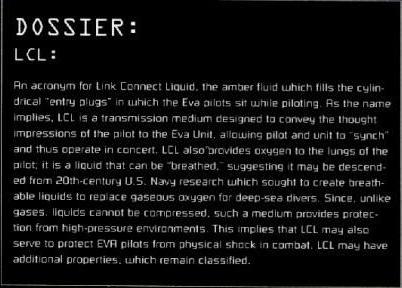
It is unknown what the initials "LCL" stand for within the anime series, but we do know what they don't mean. According to the Death and Rebirth program book (special edition):
Incidentally, the widely circulated idea that L.C.L is the abbreviation of "Link Connected Liquid" is incorrect.
Evangelion Chronicle also suggests::
One explanation is that L.C.L. stands for "Link Connected [sic] Liquid". Another possible explanation is that the L stands for "Lilith", considering that L.C.L. is Lilith's biofluid.
In Sadamoto's Manga version, LCL is said to stand for Link Connect Liquid, written in the Dossier before a chapter starts.
Gainax ran out of money and/or was censored
Easily the most enduring myth around the production of Evangelion is the notion that the series' ending came about as a result of a lack of money and/or censorship by the network. In reality, Evangelion's troubled production was mostly a result of poor planning, changing decisions and running out of time. Restrictions set by the producers and the network were minimal, the only significant instance being the death of Toji being changed into him losing his limbs to avoid backlash from TV Tokyo. For a similar reason, the network demanded to see Episodes 25 and 26 before airing, after controversy from Episode 24 - the network executives found Kaworu's death too gruesome. There are also other factors that influenced production, like the Aum Shinrikyo attacks in 1995. This is also one of the reasons why the series was not released before or along with the promotional manga as initially planned.
The lyrics of A Cruel Angel's Thesis have messages about the plot
A rather natural assumption asserts that Evangelion's theme song, A Cruel Angel's Thesis, has a hidden meaning for the show and helps illuminate plot points. In fact, this song was written with very little involvement from the show's creators, as the producers did not allow the anime staff to even meet the music staff. The songwriter, Neko Oikawa had no prior knowledge of the show, and simply skimmed through a proposal of the show (possibly Neon Genesis Evangelion Proposal) and watched two unfinished episodes on fast-forward, only serving to broadly "fit" the anime after the fact (Oikawa's interviews are referenced in the main article on A Cruel Angel's Thesis). Singer Yoko Takahashi also had no knowledge of the series. Anno originally wanted to use an excerpt from Borodin's Polovtsian Dances in the opening, but the producers did not approve of this and instead decided to use a J-Pop song, which eventually resulted in the creation of this song. The opening sequence was not finished yet either during production of Episode 01. It is purely promotional.
It's worth noting that Komm, süsser Tod and Everything You've Ever Dreamed were written by Anno (though later adapted into English) and can be taken to be more authoritative than ACAT.
N.E.R.V. and other acronyms
...which aren't acronyms at all! Rather, Nerv is simply the German word for "nerv", like Seele is for "soul" and Gehirn is for "brain", and additionally "Wille" for "will" and "Kredit" for "credit" on the Rebuild films. Nonetheless, those terms are (usually!) capitalized in merchandise and most of the web.
The manga is the original or first version of the story, or timeline
Though this is often the case for many manga later adapted as anime, Evangelion was in fact originally created as an anime series by Hideaki Anno, and the manga was instead created as a supplemental designed to promote the TV series by character designer Yoshiyuki Sadamoto. The anime was conceived before the manga and they were meant to have coinciding releases, but due to delays anime's own production its launch was postponed, and the manga went ahead, releasing about 10 months before the series first aired.[1] The anime rapidly outpaced the manga, to the point that the chapters comprising volume 4 (which included content corresponding to Episode 8) were not released until over a year after the TV series had finished airing. However, NGE's popularity lead to the manga continuing. Despite cutting most of the series' storyline, the manga was finished in 2013, thanks to a very inconsistent schedule and multiple years-long hiatuses. Sadamoto, the author of the manga and character designer for the series (no involvement as a writer) has repeatedly stated the manga is his separate project. Sadamoto states that he "wrote the script of the manga using the anime "as a base", further implying that the Evangelion anime was produced first (even though the manga was released first). After the anime ended, Sadamoto decided to keep making the manga. Sadamoto has also stated he made the manga entirely on his own, without consulting anyone, in contrast to the anime's more collaborative production, and that all differences were decided by him. He referred to the Evangelion manga as "a reworking of a pre-existing work", in an effort to "separate it from the anime".
He has also denied links to the Rebuild movies, particularly regarding the bonus chapter featuring Mari Makinami, which he regards as just fanservice. Sadamoto also stated he had no intention to "include elements from the new movies, because [the manga] is only a comic adaptation of the TV series and old movie [EoE]. So there will be nothing of the new character, Mari."
Mari or Kaworu is a timeline traveller
Mentioned above as well as in other items: Sadamoto explains that he added Mari in and Anno has had no involvement or approved anything in the manga and he has just added the Mari bonus chapter as fanservice. This is mentioned in other instances as well. Volume 9 of the manga features two characters that bear a strong visual similarity to Mari Makinami from the bonus chapter, leading many fans to assume one of them was the same character as Mari Makinami Illustrious from the Rebuild of Evangelion films or somehow had links to her, with another theory being that Mari was Asuka's adoptive sister, impossible as the manga's Mari was already 16 years old in 1998, whereas Asuka's adoptive sister is still a child in 2005. Additionally, this chapter was written before the launch of even Evangelion: 1.0, many years before Mari was so much as conceptualized, and her later appearance in the bonus chapter almost ten years later was denied as being purely fanservice, as Sadamoto had no involvement with Mari's character besides her design, said he "couldn't use her in the manga", and has repeatedly denied links between the manga and the Rebuild movies. Thus, Asuka's adoptive mother and sister in the manga are entirely different characters, and not Mari.

As mentioned in other sections, this also does not apply because of the spin-offs non-canonicity according to their own creators, as well as the myth of the manga being the "original" story - see above. In Kaworu's case, there are only two spin-offs in the entire franchise that so much as play with the idea of timelines or multiple universes at all, Campus Apocalypse and Angelic Days. Using them as an argument also omits Kaworu's relatively low importance and presence in those spin-offs: the former is a "paranormal" story centered on Rei/Shinji only using a "Yggdrasil" as a vague Norse reference plot point of holding the "fabric of reality" that is however completely extraneous to the rest of the entire Evangelion franchise, and the latter is a romantic comedy that focuses on Asuka/Shinji. Kaworu even offers Shinji to stay in a sort of pocket dimension with him as children forever, and Shinji refuses. Kaworu even disappears from reality after that instance, and in the following chapter is shown helping Gendo and Yui get together in the past, as well as briefly wishing well for Shinji and Asuka's relationship in the future. This is the only spin-off that ever has any character traveling in time. In Shinji Ikari Raising Project, Kaworu is also present only for a very short period as a "spy" for Seele and is used as comic relief in this ecchi comedy story, only to then completely disappear from the story for the remaining 10+ years of publication. Mana Kirishima, an extracanonical character from the Girlfriend of Steel videogame, has the exact same treatment but a longer presence. Overall, Kaworu is not even present in the majority of spin-offs and games, and when he is it's usually only to fight him. As mentioned elsewhere, the nature of these spin-offs is purely commercial and they are sprinkled with teasing and fanservice for fans of all characters and pairings, and Asuka and Rei are in fact the rule, not the exception. You can also find more about it here.
Do note this might not apply to the "Sequel Theory" concerning the anime and Rebuilds alone, depending on whatever happens in the final movie. This also does not leave out the possibility this might apply in some sense, even a self-contained one within the Rebuilds alone, to Rei as Quantum Rei, which at least in the series actually does have a non-linear existence across space-time.
The manga, spin-offs and/or video games are canon or complementary to the series
See also: What Is Canon?
See above. In The Notenki Memoirs, it's even commented just how indifferent Anno was to derivative material. In the 2021 NHK documentary, Megumi Ogata also states that Evangelion not written by Anno isn't "real Evangelion". This of course also applies to merchandise. All of these are done purely for commercial purposes, largely by third-parties. Hayashibara also treats them as simply fanservice and not "Eva":
- "It's been like that for a while now, but for better or worse, there have been various "Evas" between movies, and as for Rei, her flesh and blood voice hasn't been interrupted for the past eight years. There have been various collaborations such as pachinko and video games. However, these are just recreations of famous lines from the past, or the incorporation of lines from the past into current games so that people who enjoy the games can remember the past. Only "Eva," Anno's new creation, is ultimately the present, the future, and the new work. When I touch it, it has a juiciness and freshness like a freshly peeled fruit, which makes me nervous but also happy. First of all, I didn't expect another Rei [Ayanami Rei (tentative name)] to be so talkative. I've said this many times before, but when Ayanami Rei blew herself up in the TV anime series, she was over for me. I felt as if I had said goodbye to her, but then the Rei appeared again in the form of "maybe the third one," and after that, every time she appeared in one of the many Raising Projects or games, I would think that this was the fifth, sixth, seventh, or eighth Rei, and I would try to make sense of her in order to make my I've been working with her, making sense of her to make it easier for me to do my job." - Megumi Hayashibara, 3.0+1.0 booklet interview
-
As examples, here is the scenario from Neon Genesis Evangelion 2 in which Maya and Aoba form a relationship
-

official art with Rei and Kaworu, from the Die Sterne artbook
-

It's A Miraculous Win, an official spin-off with a Kaworu look alike dating an original female character.


It is standard practice in the anime industry to profit off material aimed at specific sectors and niches of fanbases by licencing intellectual property to a multitude of outsourced companies, and Eva is one of the most significant examples of this in anime history. Virtually every character has material implying romantic and sexual involvement with Shinji and many others. As such, derivative material such as this should never be taken as canon, as they are made for purely commercial purposes by outsourced companies with typically no output from the creators of the show, and support virtually every conceivable relationship in the Evangelion franchise, or even create new ones completely absent from canon or contradicted by it. Videogames have even created no less than five original characters as possible romantic interests for Shinji: Mayumi for 2nd Impression, Mana for Girlfriend of Steel 1, and Satsuki, Aoi and Kaede for Shinji Ikari Raising Project. Except for Mayumi, all of these are also featured in the manga adaptation of SIRP. The latter three are also adults. This should hardly be surprising, considering the sales of merchandising and other licenced material actually make up the bulk of the anime industry's profits, not advertising or home media. As previously mentioned, Evangelion is not a niche cult classic in Japan, but it is fact one of the highest grossing media franchises of all time - higher than The Simpsons (!), and pachinko and merchandise sales make up over two thirds of its revenue. It is, in fact, harder to find a pairing that has not been featured in officially licenced material (see image). Even Anno himself is quoted as saying:
- "ANNO: As for all the merchandising, it's just a matter of economics. It's strange that Evangelion has been a hit. Everyone in it is sick!" - Hideaki Anno's Roundtable Discussion
This is also linked to the common perceptions in English-speaking fandom that Anno had limited commercial intentions for the franchise. In reality, in Schizo & Parano and the 1.0 CRC, Anno details his plans for expanding the franchise to new creators in a manner like Gundam since the very beginning - although none of these would be integrated into canon. The Rebuild movies are intended to serve as "foundation" for this. Even so, much of the 1990s and 2000s era spin-offs, merch and games were created without Anno's knowledge as Gainax was quite liberal with its licence.
Evangelion is a small, niche franchise with no commercial aims

This one is a bit curious, and mostly seen in the English speaking fandom, by virtue of the problematic and messy history of the availability of Evangelion in English speaking markets leads many to assume Evangelion, as a franchise, is a small, underground cult classic. This claim however disregards, or simply isn't aware of the absolutely gigantic influence Eva had on Japanese culture and media, often being cited as a redefining work for the entire anime industry and beyond, personified by the gargantuan popularity of Rei, the "Premium Girl", enjoyed for years, as well as the hundreds of characters inspired by her. Evangelion is, in fact, a pop culture phenomenon in Japan and even attained relative mainstream status in a good portion of the West. Another effect of this misconception is surprise at the variety and perceived shamelesness of Evangelion merchandise nowadays, when in fact that already existed in enormous amounts even before the series was finished airing. E-Mono is an example, a 143-page merchandise catalogue from 1997. A very naked example can be seen in the revenue of the Evangelion franchise, which as of 2019 (thus not accounting for the record-breaking Evangelion: 3.0+1.0 Thrice Upon A Time, and most other data is outdated as well) surpasses franchises such as Final Fantasy and One Piece at roughly US$ 12 billion.

Part of it is attributable to the earlier statements and general conduct of ADV Films, the first localizer of Evangelion back in the 1990s, as at one time their staff had major influence in English fandom, and later other American anime companies like Funimationa and Crunchyroll, and even media coverage in the Anglosphere. These often retain a strong "fannish" component to this day, leading to inconsistent levels of quality and professionalism, so they often treat properties such as Eva as something a lot more niche and underground than it really is, reflecting their own experiences. The Spanish, Portuguese, Italian and French-speaking fandoms are a good counterexample, as in all of those countries anime had already reached mainstream appeal years before Evangelion was first aired, even during the 1980s, and Evangelion was shown on public television in the 1990s. This means that Evangelion was, in many aspects, simply one of many cartoons - though it of course atained notoriety of its own. This also means they have more access to spin-offs and supplementary material in their markets, fully translated, often to higher standards than whatever was available for English-speaking fans, where anime would remain a relatively niche interest and subculture until the 2010s. These spin-offs and the Evangelion manga also enjoy significant popularity in those countries on their own, particularly Angelic Days and Shinji Ikari Raising Project. Meanwhile, the English speaking market suffered from the limited availability of ADV's early VHS releases and relied mostly on bootlegs and fansubs. This is why to this very day several illegal streaming sites still utilize fansubs which many believe to be official translations. ADV would later release two DVD collections in 2001 and 2003, Perfect Collection and Platinum Collection. Each one has significant differences compared to the others. Though the Platinum Collection release is generally good, it still has some problems - the dub is the same, and it'd come years later and is still of limited availability, as its fairly limited production was then cut short by ADV going defunct in 2009. This also leads to fans having multiple official (and fanmade) localizations to base themselves on - though this has become less common after the Netflix release in 2019.
Australia is actually an exception, having actually gotten a public TV screening of Eva many years before Evangelion's initial, limited (though too small a market too make an impact versus the US, UK and Canada) and heavily edited screening in Toonami in the US in 2003. A later, unedited airing in Adult Swim in 2005 brought in a new wave of English-speaking fans, particularly Americans.
Anno is disgusted by Evangelion getting "milked" and is a recluse auteur
An extension of the idea that Anno hates his fans, that Evangelion is a niche, underground cult classic is the notion that the extensive commercialization of Evangelion through merchandising, spin-offs and more is somehow against the spirit of the series, or that it is out of Anno's control, who is supposedly a recluse, anti-materialistic auteur. Some fans even claim that this motivated him to make not only EoE, but even the Rebuilds as some sort of "rebellion". Refer to the two sections above for more detail into this, but also the section on why the Rebuilds were made and the future of the franchise. In actuality, Anno was keenly aware of everything, and has no shame in commercializing this gargantuan franchise, in fact he even wants to take it a step further, and this has been the case since before Evangelion had even been released.
As for Anno himself, he is actually a sort of superstar in the Japanese cultural industry, and has been for decades. He is considered the successor of Hayao Miyazaki and most of his films had big viewerships. Neither is he a recluse. Before making Eva, Anno even had a reputation as a serial womanizer up until his 30s and bouts with depression. This is mentioned in Notenki Memoirs, as well as the comedy drama series Blue Blazes, which chronicles the college life of Anno and a few other classmates at the Osaka University of Arts, some of whom would go on to found Gainax. It was later adapted into a live-action TV series. Anno, by now a 60-year old Japanese businessman who made a fortune through real estate, enjoys enormous societal prestige through Evangelion, though not exclusively Eva. The making of Shin Godzilla was a major achievment by Anno, as getting Toei and Toho to work on the same film took enormous political pull and goodwill, as did the close involvement of the Japanese government and military. Some Western fans mistakenly believe Anno was being critical of the government - it is domestically interpreted as critcising only the lethargy of elected officials, but praising the military and bureaucrats who "just get the job done", often in reflection of the 2011 earthquake. Nonetheless, the Japanese government itself has a glowing seal of approval for the films, and successive right-wing Japanese prime ministers, including Shinzo Abe, have praised it for its nationalistic appeal. The Art of Shin Godzilla, a sort of CRC for the film, also mentions cut ideas of deeper political involvement, even having Toho ask him to remove the active participation of the Japanese Imperial House. Gwern's source anthology opens with nothing Anno's nationalist conservative and occasionally anti-Western views, as well as multiple statements regarding the necessity for Japan to lead the world of animation, and annoyance at competition from Taiwan or Korea. This also plays into it having had massive success in Japan, unlike mixed Western reception.
First Impact killed the dinosaurs
First Impact was never depicted or directly referred to on-screen. This has led several fans upon first glance to incorrectly assume that because the "Second Impact" was supposedly a meteorite collision, the "First Impact" was thus the more well known asteroid impact which caused the mass-extinction of the dinosaurs at the end of the Cretaceous period, 65 million years ago.

However, First Impact (aka "Giant Impact") was actually the collision of a giant spherical object, designated the "Black Moon", into Earth approximately 4 billion years ago. As a result of the impact, huge amounts of debris, including the Black Moon's rocky exterior, were thrown into orbit, eventually coalescing into Earth's satellite, the Moon. This was made clear in the Classified Information. The "meteorite" theory in the above textbook page is a cover story, and is part of the effort to also blame Second Impact on a meteor.
"Barons of Hell"
Almost from the beginning of Eva fandom, there has been an internet rumor that the Evangelions are based upon Biblical entities called "The Barons of Hell". There are two problems with this theory:
One is that there is no such thing as a "Baron of Hell" mentioned in the Bible or in any other Judeo-Christian source; extensive searches for the term have turned up only references to Eva and the video game Doom. Some sources claim that the Barons are the same thing as the "Four Horsemen of the Apocalypse", but the descriptions given to the Barons don't match up to the Horsemen.
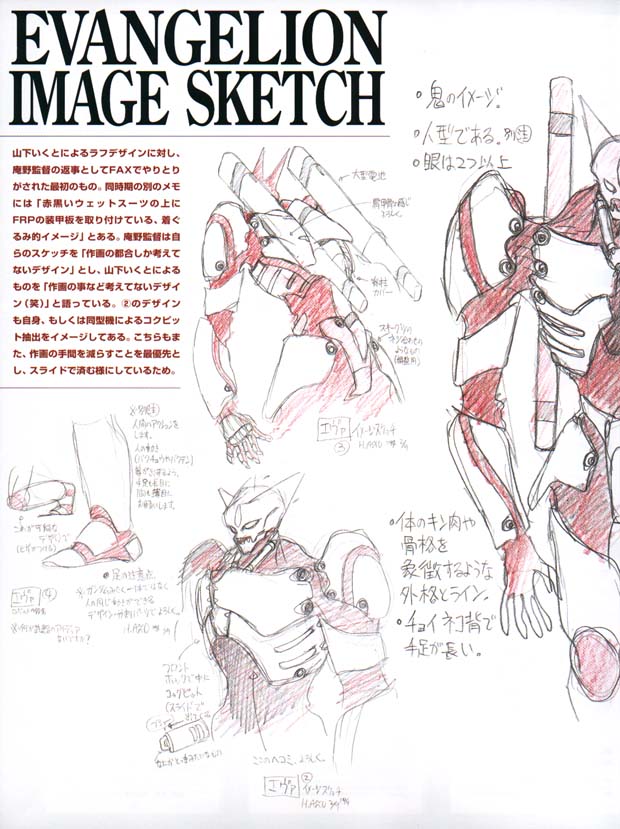
The other problem is that we know exactly what the Evangelions are based upon. Evas were fundamentally based upon the oni (commonly translated as “demon” or “ogre”, but actually a specific type of Japanese monster). Says Anno himself (in an interview published in Aerial Magazine):
There's a monster in Japan called the Oni; it has two horns sticking out of its head and the overall image of the Eva is based on that. I also wanted to give the impression that beneath this ‘robot monster’ image is not so much a robot, but a giant human. - Anno's Roundtable discussion
An early sketch Anno did of an Eva clearly betrays their oni roots. Working from this basic premise, and corresponding with Anno along the way, Ikuto Yamashita developed the Evas as we know them (with the exception of EoE's “harpies”).
Kids born after 2I are soulless
A bizarre idea used to explain the drop in the birth rate after Second Impact, and why only kids born after Second Impact can synch with the Evangelions. This theory has no basis whatsoever as Ritsuko explicitly states in Episode 20 that Shinji, born after Second Impact, has a soul.
Only children born after Second Impact can pilot Evas
An idea that for some reason is still present even in synopses and guides for Evangelion on multiple sites, the idea here is that Shinji, Asuka, Rei and Toji are designated pilots because specifically because they are born after Second Impact. Though this is not strictly incorrect, this leads the reader to assume that the post-2I world has some sort of effect in children born after that event, but there is no evidence or even any allusion present in the show whatsoever, since the actual reason they are selected as pilots is instead because of the link they share with their mother's souls embedded in the Evas. It is implied that Hikari, Toji and Kensuke have all lost their mothers as well, and this presumably extends to the whole of Class 2A - some speculate that Nerv has some sort of "soul bank" with each pilot candidate's mother's soul.
Naturally, Rei and Kaworu are an exception since they have a direct link, possessing part of the souls of Lilith and Adam respectively. It's worth mentioning that their birth dates are also not at all important or even mentioned in the actual show and merely are one of the instances of it being retroactively imprinted using their voice actors' birthdates, as is common anime industry practice.
Spear of Longinus is the actual holy relic (that just somehow got big)
This is a product of putting too much stock in NGE's religious references. The Spear was actually excavated in Antarctica along with Adam, who was found impaled upon it. According to the Classified Information, each Source of Life is accompanied by a Spear that has a will of its own and can immobilize a Seed for going against its mission. Thus, the Spear of Longinus is billions of years old—not made by a Roman blacksmith—which impaled Adam for committing an unspecified offense.
A.T. Field is a real-life psychology term
Since the very earliest days of Evangelion analysis, there has been a rumor that A.T. Field is a genuine psychological term that describes the barrier that separates autism patients from the world around them. However, extensive searching for online Psychology researches and forums has failed to find any use of the term other than in reference to NGE. Further research by those in the field has proven that "Absolute Terror" or similar terminology is simply not recognized in academia. Therefore, this rumor is false and has been conclusively proven so.
Some examples of fan-pages propagating this rumor: 1 ; 2
Rei and/or Kaworu are a representation of Shinji's unconscious
An example commonly cited when discussing the conceptualization of Eva, stemming from a mistranslation or misreporting of an Anno interview. This interview was published in the November 1996 issue of Newtype Magazine. Anno says that he identifies with Shinji in both a conscious and unconscious manner (also mentioned here), and he, Asuka and Misato are close to himself, while Rei is Anno's "deepest part" and Kaworu his Jungian shadow, not Shinji's. Naturally, Shinji being mentioned as one of the items makes this claim even shakier. This is a rather long interview containing several famous excerpts but hasn't been fully translated, though several other excerpts are available on gwern's source anthology, and the relevant section has been summarized in the forums.
Referring to his original intention, Anno notes also notes:
The plan was that the ‘unconscious Shinji-kun’ would be Ayanami Rei, the Shinji-kun who appears on the surface would be Ikari Shinji, and the ‘ideal Shinji-kun’ would be Nagisa Kaworu-kun. [Kaworu was] supposed to be an ideal male but when I tried putting him together he was just a strange fellow (laughs). That was something of a lack of capability on my part. - Interview ‘with a member of Waseda University for the purpose of “character study.”’
Anno: [He is an ideal Shinji] Because he is a character who has been cleared of all of Shinji's complexes. Well, that part doesn't come through clearly due to shortcomings in my depiction. - 1st June interview.
The problem here is that Anno never makes it clear if he held on to the idea of Rei being an unconscious Shinji - in other interviews he echoes having had problems with characterizing Rei as she's part of his unconscious and somewhat hard to connect with. It Is much more clear with Kaworu, nonetheless.
Anno deliberately modeled characters on certain people
Another common claim. Although VAs like Yuko Miyamura and Yuriko Yamaguchi (Ritsuko) have influenced characterization to varying degrees, Anno is quite adamant about characters being first and foremost based on him. Some of the common claim include:
- Misato is claimed to be based on Noriko Hidaka, voice actress of Jean from Anno's previous work, Nadia. This claim comes from a widely disproven slander document, the Kaibunsho:
When the TV version of “Nadia” launched, Anno confessed his feelings to Hidaka Noriko. This is a famous story in the industry. Apparently Anno told her that he “looked at her not as an object of adoration/longing, but as a serious love interest!” (ROTFL!)" [sic] - Kaworu being modeled on a real person or experience, but this has been denied long ago by both Anno and Sadamoto:
"What about whatever research you’d done?
Anno:There was none."
[...]"Telling someone or being told by someone, “Your heart is like glass,”—did anything like that actually happen to you?
Anno: Nope, nothing like that." - JUNE interview
—When you designed Kaworu, did you base his looks on someone?
Huh? No. But, as the last Angel, if I make his profile a combined form the of people that the past Angels made a contact with——what about something like this——I have this concept. That is why some parts of Kaworu look like Shinji, some parts look like Rei, some parts look like Asuka. - All About Kaworu Nagisa interview
Neither is this ever even alluded to in multiple Sadamoto interviews detailing his design, or sources like the Newtype Film Books or Evangelion Chronicle. - Gendo on Anno's own father seems unlikely considering Anno was quite open about having a good relationship with him. Instead, Gendo is described as representing the "pressure of society":
"Ikari Gendo is not exactly popular in Japan. Many think that he is too stern with Shinji and that he generally exudes the aura of a hard, traditional, strict father. Gendo was meant to be a strong father who should have a positive influence on Shinji so that he could grow to be more confident and adult-like. Many modern fathers in Japan are “mollycoddled” which was another reason to make Ikari Gendo into a strong father." – FUNime interview with Kazuya Tsurumaki, English translation by Kendrix
In fact, Anno's father seemed to have influenced Toji of all people:
"My father has only one leg. While working at a lumber mill he had his left leg seriously injured with an electric saw. He was 16 years old at the time. He wears an artificial leg below the thigh. He has trouble walking, so he used to stay at home.
But there is no doubt that I have been influened by father's physical handicap. I cannot love anything perfect."- Disability Shapes Taste for the Imperfect
Oizumi: About the complex you have because of your father's body... you said, for instance, in an interview with Animage that even when drawing a robot you're not satisfied until you've erased some part of it.
Anno: Probably I have an attachment towards deformity. I can't love [something] if it's not broken somewhere. I believe that's [due to] the influence of my father['s condition].
Oizumi: The Evas often got deformed as well (laughing).
Takekuma: Toji lost his leg. Why didn't he die there?
Anno: I couldn't kill him.
Takekuma: Of course.
Anno: No, um, I made a certain promise, though I think now I should have broken it. At the very beginiing, when [we] drew up the plan [for Eva], [I met] with the producer, from King Records, who told me, "I will approve the plan you submit, whatever it is, because I have faith in you. However, there will be two conditions. The first one is that you will remain with me for five years. You cannot, for example, do a film version with another [producer]. The additional condition is that you will not kill any children. The adults can die, but I don't want children dying." Because of that condition I couldn't kill [Toji]. - Schizo/Parano - Rei on Anno's mother is likewise an apparently natural assumption that Anno has denied. As mentioned elsewhere, she is Anno's deepest unconscious self:
Oizumi: Exactly. And, on the topic of substitutions, can we think of Rei Ayanami as being a person like your mother?
Anno: That’s not quite right.
Takekuma: There’s also nothing like the image of a girl you previously dated [in her], right?
Anno: No. Well, Rei is probably [the character] closest to my deep psyche. I don’t really understand her. … The truth is, I have no emotional attachment to her at all.
Takekuma: Huh? Is that right?
Anno: Yeah. I have no emotional attachment to her. Well, Nobita-san wrote [about her] as being a symbol of schizophrenia. There were parts where that was actually what I wanted to do [with her].
Takekuma: But she is the character best received by the fans in the outside world. Even I was drawn in by Rei at the beginning.
Oizumi: That’s right. Megumi Hayashibara’s voice was also incredible.
Anno: But Rei is [the character] I least understand. In addition, I’m not really that interested in her. There were parts where that’s what I was consciously doing, actively trying to put aside my presuppositions, trying to bring out the most primitive, the most core, the purest parts within me.
Oizumi: So Rei is perhaps [something] embedded in your unconscious [that] can’t be expressed in words.
Anno: Even in the midst of making Eva, I suddenly realized I had forgotten her. Her very existence. In episode seven, I remembered, and added a single shot with Rei. I had no emotional attachment to her at all. I think that was fine, because she didn’t appear in episode eight, not even for a single shot. -Parano - Mari on Hideaki Anno's wife, Moyoco Anno: she has commented on associating herself with Mari on her paid fan newsletter, from April 2nd 2021: Don't compare me with Mari. It's great that people are talking about "Shin Evangelion" and their thoughts on it, but... But please don't compare me to the work any more than you have to. Please don't make me feel uncomfortable about it.
Khara staff and official account had also commented also commented on on Gainax co-founder, Toshio Okada, talking about it on his Youtube channel: Another disgusting video came around. I've never had any contact with the director, and I've never met Toshio Okada. I think it's time to stop making insulting remarks based on crazy assumptions. ; "Toshio Okada hasn't even met Anno for a quarter of a century, and he's never met Moyoco. And yet, there are people who misguidedly say that Mari is Moyoco and believe them. The most misguided part." ; "Mari only has Tsurumaki-san's libido in her. She has glasses, is strong, and could have been in FLCL. She's also a character with the same dialogue." - Hideaki Anno did comment on Moyoco in her 2002 manga Insufficient Direction: "My wife's public image is that of a strong woman, but actually she's very sensitive, fragile and weak. She constantly has to face her difficult past, and she couldn't escape the reality of having to provide for her family. It's just that she needed to don a piece of armor called "toughness" over her heart. I can sense that deep inside she battles loneliness and alienation and is barely holding her emotional balance in check." SAKAMOTO: Anno provided me with one little “hint” to better understand Mari: “Showa no Oyaji” [Father of the Showa Period/ The “typical” Japanese parent from the '70s and '80s]. After realizing what he meant, I managed to improve my performance totally. - Evangelion 3.0 theatrical booklet interviews'
See Character Name Origins for comments by Anno himself on naming the characters. Overall, Anno emphasizes that all characters in Evangelion represent different aspects of himself.
Eva-00 has the soul of Naoko Akagi or none at all
The most accepted theory is Rei I's soul, being in turn a portion of Lilith's own soul. Please visit Eva-00's soul for more information.
Someone we know killed Kaji/Misato killed Kaji
.png)
This is one of the most famous early misconceptions. Usually, the piece of evidence used is the original cut present in the On-Air version of Episode 21. This theory shocked Anno so much at the time that he'd later rectify it in the Director's Cut version of Episode 21 by changing the previous "evidence" for this, a shot of her room's door with her name on it, which was changed to just a shot of her apartment complex. This is one of the few cases of a straight-up retcon in Evangelion.
This was controversial enough to be addressed by Newtype at the time: "While a lot of fans think that it was done by Misato, Director Anno raised the possibility that it could have been done by Japan government or Seele agent". The film-book also states that the killer was not a main character.

…Who killed Kaji? What’s your version of it?
This is a question that many Japanese fans also wonder about. Kaji wanted to investigate a deeper part of NERV (SEELE) and learn of its secrets. He was tricked by one of his informants and then killed. It wasn’t Misato or Ritsuko. - Tsurumaki, FUNime March 2002 interview
Rei and Kaworu are actual albinos
Actual albinos don't have light blue hair! Albinos cannot walk outside without protection, otherwise they would suffer severe sunburn, and most have very poor eyesight. On the contrary, Kaworu's eyesight appears to be exceptional (such as his noticing Misato in the Episode 24 director's cut lake scene). It is worth noting that Ritsuko's complexion is only slightly darker than Rei's, although she's obviously not an albino.
Kaworu was not a clone, and had a "natural" human appearance
This theory posits that Kaworu's human appearance was naturally occurring like those of the other Angel's or even chosen by him in order to enter Nerv. In fact, he was created using human DNA and an Angel's soul, being the Seed of Life Adam, just like Rei was created with Yui's DNA and Lilith's soul.
Episode 21':
Man E: "The contact experiment with the donor is scheduled for the 13th of next month. There will be time for any adjustments."
(later) Woman B: "The genes that dived into Adam have already undergone physical fusion!"
Episode 24':
SEELE A (speaking to Kaworu): [Adam's] salvaged soul exists only within you.
Neon Genesis Evangelion 2. Classified Information: Adam.:
"At the time of Second Impact, [Adam's] body was torn apart, and its soul flew off somewhere as a result. Adam's soul was later recovered by Seele and incarnated.", whom they may have recovered in embryonic form in Antarctica.
Kaworu's human DNA donor, however, is unknown. See: Theory and Analysis:Identity of Kaworu's Donor
Toji not only loses his leg, but his arm as well
While Toji's left leg is plainly missing when he's on the hospital bed, it's not certain to tell if his left arm is, as well. However, both Toji's arms are seen as he is being hauled out of the entry plug. In an interview, Anno is asked about Toji's losing his leg, but does not correct the interviewer about his arm.
Takekuma: Toji lost his leg. Why didn't he die there?
Anno: I couldn't kill him.
Takekuma: Of course.
Anno: No, um, I made a certain promise, though I think now I should have broken it. At the very beginiing, when [we] drew up the plan [for Eva], [I met] with the producer, from King Records, who told me, "I will approve the plan you submit, whatever it is, because I have faith in you. However, there will be two conditions. The first one is that you will remain with me for five years. You cannot, for example, do a film version with another [producer]. The additional condition is that you will not kill any children. The adults can die, but I don't want children dying." Because of that condition I couldn't kill [Toji]. - Schizo/Parano
The original storyboards for The End of Evangelion also contain a scene showing Toji playing wheelchair basketball with Kensuke, where he clearly has both arms, eliminating the possibility that one of his arms was amputated.
However in Neon Genesis Evangelion: ANIMA, Toji indeed loses his leg and arm. He has a cybernetic implant in its place.
Naoko's Brain in Magi
Or any other brain for that matter. This is due to the brain-like object Ritsuko reveals when she cuts into the Magi in episode 13. It is clearly stated that the Magi merely have personality imprints of Naoko Akagi - herself as a mother, scientist, and woman. The computers are also far too large to be actual human brains.
Naoko's Soul in Magi
Likely originated due to the fact that the Evas have the souls of their pilots' mothers. There's also the issue of Caspar 'betraying' Ritsuko in The End of Evangelion, but machines cannot be implanted with souls (and hence can't project A.T. Fields, as was clear in Episode 07).
Keel is the Wandering Jew
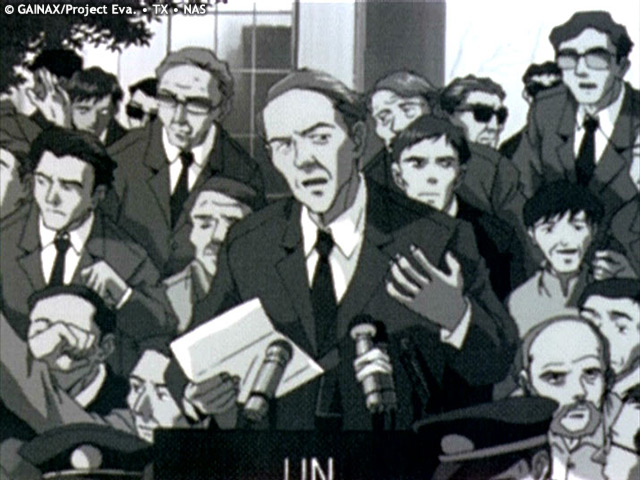
One of the most bizarre myths about Evangelion. There is a pseudo-biblical myth that claims that an onlooker at Christ's crucifixion spat upon him, and was punished by receiving the curse of immortality. He thus became the "wandering Jew", never able to make permanent friends or stay in one place, lest people notice his never-aging nature. The theory goes that Keel's motivation in bringing about Instrumentality would at long last allow him to die.
There are, at the very least, two huge problems with this notion. One being there's absolutely nothing in the series to indicate this is Keel's motivation. The other is that when Keel appears in a flashback in episode 21, he is visibly younger than in the series' present, and as has been noted, the Wandering Jew is supposed to be ageless.
The Dummy Plug Plant is the Chamber of Guf
The Chamber of Guf is mentioned by Ritsuko in episode 23 when she, Misato, and Shinji are down in the Dummy Plug Plant. This comment likely lead people to believe the two were synonymous. Please look here for an explanation of Guf within NGE.
Adam was impaled on the Spear of Longinus by Lilith
The "Duel of the Seeds" idea was made up to explain why one Seed would be skewered by the Spear of Longinus and placed in suspended animation while the other would be free to spread life on Earth. The interaction between Rei and Kaworu was interpreted to mean that both of them (as Lilith and Adam respectively) had interacted previously. This idea was disproved when the Classified Information files revealed that each Seed was sent with its own Spear, and that Lilith's Spear was either lost or destroyed during First Impact. Adam was placed in suspended animation by its own Spear, which was used to impale Lilith later on.
Death's string quartet scenes don't take place in the actual timeline
While until lately the predominant idea was that the string quartet scenes are simply artistic linking devices that don't truly take place in the series timeline, a more logical idea instead pertains that they actually do-it's just that the characters featured there aren't Shinji, Asuka, Rei and Kaworu, but rather characters who look like, sound like and have some basic characteristic similarities to them. Considering the heavy focus put on giving a concrete time and place for the scenes (an illogical thing for a surrealistic scene), it seems logical to assume this is the time and place when these scenes transpired in the timeline, instead of merely more confusing abstraction. Moreover, none of the musicians ever have their entire faces in a frame. Beyond that, there are also no links made between the musicians and the four pilots unlike other times in Death when there is a clear connection made between a character whenever a timejump is made. Furthermore, the official book The Evangelion Chronicle: Side B explicitly calls the musicians different characters.
A line from the book reads as following: "Before the Third Angel attacked, a quartet of boys and girls gathered in the school auditorium of the Third Middle School in Tokyo-2 to perform "Pachelbel's Canon". These young musicians bore an uncanny resemblance to the four Children upon whom the world's fate would come to rest." So it is made absolutely clear that the instrument players are not the main characters.
Additionally, from the Refrain of Evangelion booklet: 1. Suiten for Violoncello solo Nr. 1 G-dur, BWV. 1007 1. Vorspier
This is the opening for EVANGELION: DEATH and an introductory part of Bach’s unaccompanied cello suite #1 played by a boy who looked just like Shinji.
See also: Death's string quartet scenes
Death threats, and "Anno's Revenge"
Main article: End of Evangelion Death Threats
Many are lead to believe, one way or another, that The End of Evangelion was Anno's revenge against the fans for the negative response received from the ending of the TV series.
Some say it is because Anno brutally killed off all of the main characters; however, this isn't anything new in the world of anime. Most notably, Yoshiyuki Tomino's Space Runaway Ideon, where not just all the main characters are killed off, even children are brutally massacred. Even though Ideon may be one of Anno's biggest inspirations for Evangelion, the End of Evangelion was closer to the planned ending to the TV series Anno's October 2013 interview. Some of the footage used in the TV series ending (corpses of Misato and Ritsuko) indicates that, even before the TV series ended, Anno had planned on killing these characters.

Some say it is because of scenes such as Shinji visiting the sedated Asuka in her hospital room. Although slightly out-of-left-field compared to the ending of the TV series, this scene does serve its purposes. Most importantly, it shows that Shinji has hit the lowest of lows, and secondly, it's referenced later in the movie when Asuka says "Idiot! I know about your jerk-off fantasies of me. Do it again like usual... I'll even stand here and watch."
A subjective argument for Anno's revenge is the cinematic and narrative mindfuck that takes up most of the 2nd half of End of Evangelion. A subjective retort could be, "What about the end of the TV series?". As far as a non-subjective response, films have been known to use clashing motifs, non-linear storytelling, and highly symbolic/obscure imagery, and the End of Evangelion isn't the first to use all three. Also, from an interpretive standpoint, the second half of the movie does very well in showing the chaos and disembodiment of Instrumentality, specifically, what Shinji was going through.
Finally, some argue that the smoking gun for Anno's revenge is the sequence of quickly flashing (about one per frame) death threats/hate mail which can be seen at the end of the live action sequence in the second half of the movie. However this rumor was started, it was probably propagated by the Commentary track on the Manga Entertainment release of End of Evangelion, where Amanda Winn Lee gives a mention of hate mail during this sequence The End of Evangelion Audio Commentary. Since these have been translated to English, the majority of the letters and emails are that of personal attachment to the show, praise, or encouragement/anticipation for the End of Evangelion movie. Out of the 25 letters, only one of the emails can be considered 'hate mail', and it was criticizing Death and Rebirth (not the end of the TV series at all), and the only 2 possible instances that could be considered a 'death threat' was graffiti on the wall outside of Gainax's studio (which was hypothesized to be from religious fanatics) and an email that said "Anno, I'll kill you!!!", which was a close-up of only that message on a computer monitor and lacked any context whatsoever. Almost all letters were positive or neutral. This puts the smoking gun argument on very shaky ground, as this sequence isn't used as a "This is why I'm taking revenge on you people" message, or anything along those lines. Another theatrical pamphlet for EoE claims that the letters are simulations to explore the relationships "between a work and its admirers". Moreover, Anno has revealed that the letters shown were actually writen by a friend of his, as he could not use the actual letters for legal reasons.
"It was popular at the time, and it is popular now. I thought of everything in the letters. If you write the real thing, it causes a lot of trouble. The person who wrote the abusive/slanderous stuff, is actually a really old friend if mine. He wrote it really well. It seemed like something that could be real." - Anno, Tokyo International Film Festival
"First of all we didn't use a sad ending to annoy fans. When they're upset, that really bothers us. Personally, I think a happy ending is fine, but not if it is achieved too easily. That's no good." - Assistant Director Kazuya Tsurumaki
The series is the "true ending"
Thanks to the many urban myths surrounding the production of Evangelion, as well as the "revenge" myth mentioned above, some people assume that the series' ending in Episode 26 is the real, "original" ending, with EoE being a response. However, supplemental material and interviews clearly state that Episode 26' in EoE represents Anno's original plans. Instead, EoTV, while still important and thematically relevant, was made that way because of the lack of time to appropriately represent Gainax's intentions. This does not discard EoTV, however, and EoE is generally considered to be, thematically if not narratively, a complementation of EoTV and not a complete replacement.
For instance:
- I couldn't draw it out for various reasons, but as far as episodes 25 and 26 (the last episode) in the original storyline, I even had the plot for episode 25. Episode 26 was abandoned at the plot stage. We'll rework the original episodes 25 and 26 in the video and LD that will be released next year, but for episode 26, we're going to rework it again visually. If I can't come up with anything, I'll take that plot apart and do it again. The episodes 25 and 26 that aired on TV were a direct reflection of how I was feeling at that point in time, so I'm happy with them. I don't regret it.
March 4. After the end of the voice recording of "Evangelion" episode 25, the staff and cast members held a party near the Tabak recording studio in Tokyo.
Anno: At that time, the script for the final episode was not yet up. It was all done the following week. We only had three days of drawing work in fact. To be honest, I don't think it even needed to be drawn up as an expression. In fact, it should have been fine for me to come out and talk. I thought that'd still work, but as expected, they refused to let me. - Hideaki Anno: Special Interview to celebrate being made into a movie (Newtype 06/1996) - "Episode 25' "Air" is based on the original episode 25 script which was completed during the production of the TV series. Due to production time limits and other problems, this script was not used and the TV episode 25 "Owaru sekai (The Ending World)" instead became a drama which unfolded within an inner universe like episode 26. In this sense, episode 25' could be considered a return to the originally intended contents. In contrast, episode 26' adds much more story and dramatic content to TV episode 26, thus deepening the theme." - From Red Cross Book, available here.:
- "Anno: When I did the TV series, there was as yet no such thing as moe. I like Sailor Moon as well. For the TV series, we certainly ran out of time. We had no time for episode 25, so we remade it for the theatrical edition. The final episode, episode 26, was going to be that way originally. In the scene in episode 16 which depicts a conversation between Shinji and the angel, Tsurumaki-san forbade [the angel's use of] Japanese. So due to that, the theme became from then on conversations with oneself, and it ended with the question of how you can come to terms with other people. We did [the finale] in four days. We did the voice recording first, and then drew the storyboards." - Hideaki Anno x Kazuo Koike (October 22 2013)
With that said however, that does not mean that Episode 25 and 26 are skippable or should be discarded, as they are an integral part of Evangelion.
Both endings are concurrent
Also linked to the above misconception. One of the most hotly debated topics is whether End of Evangelion an the final episodes of the series, known as EoTV, are different perspectives on the same event. This has been known as the Concurency Theory. However, a multitude of official sources and statements by staff, including Tsurumaki and Anno themselves, make it clear that EoE is an alternative, replacement ending, and not directly compatible with EoTV, and are even explicitly referred to as "remakes":
- After all 26 episodes of the TV series were aired, the remake version of Episode Twenty-Five and the Final Episode were released as a theatrical piece, in which several of the mysteries were resolved. Or there were clues presented with which to think about the mysteries. - Platinum Booklets - Mysteries Revealed
- The conclusion to the drama and illuminating the mysteries. In response to fans clamoring for those two things, it was decided that there would be a remake of Episode Twenty-Five and the Final Episode. The result of that are Episode 25 "Air" and Episode 26 "A Pure Heart For You," which were released as the theatrical "The End of Evangelion."
Thus, the story of Eva would branch into two stories with the diverging point being the end of Episode Twenty-Four "The Final Messenger." The two stories each unfold differently and arrive at their own climaxes. Episode Twenty-Five and the Final Episode tell the theme directly. And the other version, Episode 25 and Episode 26, depict the same, following the story. It is not that one is the complete version and the other is incomplete. Just like the multiple endings of a game, two different endings were prepared for one story. - Platinum Booklets - The Two Endings - Seeing the remakes, Episode 25 “Air” and Episode 26 “A Pure Heart For You”, may in fact make the content of Episode Twenty-Five easier to understand. The depictions of Misato and Ritsuko being shot to death, Unit-02 hugging its knees in the lake, and Asuka likewise hugging her knees within Unit-02 all correspond to Episode 25.
When it was originally aired, many voiced their opinion that they could not understand the story in Episode Twenty Five and the Final Episode. However, there is actually a bare-bones explanation of the story within the show. That being… Gendo uses Rei to execute the Human Instrumentality Project and the complementation of man begins.
Gendo says, “All souls will become one and find eternal peace”. His Instrumentality Project must have been for all human souls to be combined as one and to compensate each other for what they have been deprived of. In the story that follows from Episode 25 “Air” to Episode 26 “A Pure Heart For You”, he was not able to execute the scenario he had drawn up. It may be that it was in Episode Twenty-Five and Episode Twenty-Six that his wish actually came true. - Platinum Episode Commentaries - The moment that Shinji gains conviction that it is okay for him to be there, the background changes, and the blue Earth spreads beneath his feet. However, there are no continents on this Earth, and it is covered by a gigantic coral reef. It seems this is the Earth that has been transfigured by the Instrumentality Project. This episode ends with the captions “To my father, thank you.” “To my mother, farewell.” “And to all the Children.” “Congratulations!” Eva is something of an Oedipus complex story, where a boy feels love and hatred for his father and mother, so the first two captions can be thought to means that Shinji has come to an understanding with his father and grown out of his dependence on his mother. Perhaps the latter two captions mean, “This is a world where all the children born into it deserve to live.” It is left for the audience to decide whether this ending is the Best Ending or the Bad Ending. - Platinum Episode Commentaries
At last, the [Human Instrumentality Project] has been executed. ... How about the complementation of Shinji? How about the complementation of Shinji's heart? Here the path of Shinji's complementation is described.
"Amidst the many words of congratulations, a faint smile starts at the corners of Shinji's mouth (and spreads across his face). A happy face -- that is the figure of the Complemented Shinji. This conclusion is also one form, one possibility among many." - Filmbook Vol. 9 - In other words, episodes 25' and 26' are the continuation of TV episode 24 "Saigo no Shisha".
For the TV series, episodes 25 "Owaru sekai (The Ending World)" and 26 "Sekai no chuushin de ai wo sakenda kemono (The Beast who Shouted "I/Love" at the Center of the World)" were shown following episode 24 to conclude the series. Thus, the story of Evangelion branches into two after the last scene of episode 24. There is one ending as shown in TV episodes 25 and 26, while episodes 25' and 26' as shown in "THE END OF EVANGELION" are another ending. (Here, plain numbers are used to indicate the TV episodes, and numbers with apostrophes for the movie episodes) Thus, in both name and fact, this is the complete conclusion to Neon Genesis Evangelion.
As the culmination of this trend, the final episode of the TV series, "Sekai no chuushin de ai wo sakenda kemono", took a novel approach in that the story progressed only within the inner world of the protagonist Shinji Ikari. Although this fulfilled the basic thematic requirements, the drama of the Eva characters and explanations of various settings were left unfinished as the story ended.
This became a major issue as the final episode of the TV series could be considered incomplete. The voice of the fans grew stronger as they demanded a proper ending to the drama, explanations of the mysteries, or even a new story. Thus, in order to meet these demands, it was decided to remake episodes 25 and 26.
The remade episodes 25' and 26' were originally intended for release as OVA, but during production it was decided that they would be released in theaters. - End of Evangelion Program Book (Red Cross Book): Commentary - -- What did you think about developments during the second half of the TV series?
KT - I didn't mind it. The schedule was an utter disaster and the number of cels plummeted, so there were some places where unfortunately the quality suffered. However, the tension of the staff as we all became more desperate and frenzied certainly showed up in the film.
-- I see.
KT - About the time that the production system was completely falling apart, there were some opinions to the effect that, "If we can't do satisfactory work, then what's the point of continuing?" However, I didn't feel that way. My opinion was, "Why don't we show them the entire process including our breakdown." You know -- make it a work that shows everything including our inability to create a satisfactory product. I figured that, "In 10 years or so, if we look back on something that we made while we were drunk out of our minds, we wouldn't feel bad even if the quality wasn't so good."
[...]-- Was this cinema edition made to match Director Anno's state of mind?
KT - I believe so. There was a time when Hideaki Anno clearly wanted to attempt a more cathartic development. It didn't end up that way, but I don't think we lied.
-- When you say "lie", do you mean to suddenly conclude with something like "love saved the world"?
KT - Exactly. And we didn't do that with this movie. I feel no dissatisfaction at the ending. I really like it. - Red Cross Book: A STORY OF COMMUNICATION: The Kazuya Tsurumaki Interview - Hayashibara: So there will be two episode 25s.
Anno: Right, it will be a multi-ending.
Hayashibara: So, a dual... ah, a multi-ending. After episode 24 the endings will diverge.
Anno: Right.
Hayashibara: There will be two of them.
Anno: There will be two of them.
Hayashibara: Ah, two endings.
Anno: Yes.
Hayashibara: In terms of gaming - is it called a simulation game? What do you call it? The ending for that [particular] self changes as you go on [through the game].
Anno: Right, a multi-ending [game].
Hayashibara: You took this road so you went here. You took this road so you went here. The ending changes. That's how it goes.
Anno: Um. Evangelion is my live performance. Since I create it with this sense of it being live, what I'm thinking now, what I'm feeling now, my current mood, all this gets transferred onto film - that was the initial theme, or the theme I had in my mind. - Hayashibara's Tokyo Boogie Nights, April 14 1996 - Ohmori: So we can't think of [the ending] as him as being saved, or as it being happy.
Anno: Um, well, there are probably people who see it as a happy ending. For me, personally, it wasn't very happy. In hindsight. - The World of Neon Genesis Evangelion (SF Magazine 08/1996), full translation
The Mass Production Evas have no souls, or are piloted by other Children

In Episode 24, Kaworu says that the A.T. Field is "The light of the soul", indicating that a soul is required to produce an A.T. Field. This is consistent all throughout the TV Series as well as in the movies, since the Mass Production Evangelions, in fact, do produce A.T. Fields:
- Shigeru: "The Eva series' A.T. Fields are resonating!"
Some say that it is the pilots (Kaworu dummy plugs) which produce the A.T. Field. However, Ritsuko in Episode 17 says:
- "This is the dummy plug prototype.
Rei's personal data has been loaded into it,
but it's not really possible to digitize a human mind and soul.
Ultimately, it's a fake, an imitation.
Just a machine that emulates a pilot's thinking process."
Indicating that there is no real soul in the dummy plugs. Therefore, it is impossible for the dummy plug to generate an A.T. Field.
An alternative theory is that they are piloted by the other members of Shinji's Class 2A, like Hikari, Kensuke and Toji, which would also mean that they would be embedded with their mothers' souls. Of course, this is also disproven by the Kaworu dummy plugs being inserted into them.
Adam and Lilith were once a single being/Adam and humanity both originate from Lilith
A misconception that arose from translation issues and has led to many assuming that both Adam and humanity derive originally from Lilith. This information tends to be derived from Misato's "info-dump" to Shinji in The End of Evangelion (specifically Episode 25') and a particular line that has never been translated correctly in most releases, including official ones. It is part of the following monologue:
シンジ君
私たち人間もね
アダムと同じー
リリスと呼ばれる生命体の源から生まれたー
18番の使徒なのよ
This sentence is phrased rather awkwardly in Japanese, and it is easy to get it wrong - this mistake was present in ADV/Manga's official dub and sub of EoE, most fansubs (a notable exception is Sephiroth's fansub, partly made in conjunction with EvaGeeks). The exception among official releases is the new Netflix dub, as the subtitles use an unfinished version of the translation, something noted by Khara's translator, but still not corrected by Netflix.
In the incorrect translations that are commonly reproduced, Misato is saying something equivalent to "Listen carefully, Shinji. We humans also come from the source of lifeforms called Lilith, like Adam. We're the 18th Angel", which leads one to assume that Adam also originates from Lilith. This is false, as Adam is another source of life entirely and the second sentence is correctly translated as something akin to "We humans were born from the source of lifeforms known as Lilith, which is similar to Adam." Therefore Misato was actually pointing out that both Lilith and Adam are similar, both are Seeds of Life, not saying that Adam also comes from Lilith, just as humanity.
The kitchen fight was all in Shinji's head
This is part of the Pre-Third Impact Instrumentality. Right before the kitchen fight, Shinji and Asuka witness a scene from Misato's college days, where she is having sex with Kaji. Shinji clearly has never seen this before asking "This is Misato? She does... this?" in which she replies "Yes, this is also me... The melting into one another's hearts... The me that Shinji doesn't know." If this entire sequence was all "in Shinji's head", there is no way he'd know these things. Instead, because he is already in Instrumentality, he has access to Misato's memories. This also applies to the preceding Hell Train scene.
The Asuka in the Hell Kitchen scene wasn't real
For the same reasons presented above, there is no reason to think the Asuka that confronts Shinji in Episode 26' is a fake or some sort of creation of Shinji's mind. Asuka clearly implies she knows about Shinji's masturbation earlier in the hospital, and even that it is in fact a habit of his from before. Though she might have known or suspected the latter, there is no way she could know about the hospital without having access to Shinji's memories herself. Though Asuka did die in the real world, her soul has been harvested by Quantum Rei and she is now present in Instrumentality, just like what happened to Misato herself.
Asuka did not know that Shinji masturbated to her
See above. In the original Japanese, Asuka even uses the idiomatic expression "I know you've been using me as a side dish". In Japanese, "using something as a side dish" is an expression for using something or someone for one's erotic fantasies, but with the underlying implication that the person using the "side dish" is too scared to actually act on their feelings.
Asuka didn't die
Asuka and Eva-02 were killed by the Mass Production Evas. Maya's and Shinji's horror and the mangled state of Eva-02 make it explicit. Since Asuka was suffering actual physical damage corresponding to the Eva's damage, there was no way Asuka could have survived the multiple Spear impacts or the subsequent mangling. Just after she's stabbed, Maya also yells in desperation that "Asuka is..." but is unable to finish her sentence. Although this is only (strongly) implied, it fits with her hesistancy throughout all the movie that she was going to say "Asuka is dead!". Furthermore, Asuka's bandages in the final scene correspond with her injuries from that battle. As mentioned above, her soul was simply harvested by Rei/Lilith and she later returned through Instrumentality.
The Asuka-Rei-Misato amalgamation

This very common misconception was born due to the last scene of End of Evangelion with Asuka and Shinji alone on the beach. Asuka's arm is bandaged (like Rei's in Episode 01) and her eyes appear to be brown (like Misato's), particularly in older Western releases. This leads some people to speculate that Asuka is really a combination of all three girls, and therefore Shinji's "dream girl" but this notion is absolutely false. The bandaged arm is due to her battle trauma in Eva-02 earlier in End of Evangelion (when a replica lance splits Eva-02's right arm completely). Her eyes are still blue, merely tinted due to the hue of the scene occurring at night.
Before Instrumentality ends, Rei tells Shinji "If you wish once more for the existence of others, the barriers of the heart will separate everyone once more..." while Kaworu asks "Is it okay for the A.T. Fields to hurt you and others once more?", indicating that the A.T. Fields have separated everyone from each other.
The Adam & Eve Scenario (or, Nobody Else is Coming Back)
Main article: Theory and Analysis:Final Scene in End of Evangelion Considering that themes of Genesis pop up all over NGE, the final scene of End of Evangelion leads many to assume that Shinji and Asuka are the new Adam and Eve, left alone to re-populate the world. But this theory is possibly false if we are to believe Rei and Yui when, during the dissolution of Instrumentality, Rei states, "Anyone can return to human form as long as they can imagine themselves in their own heart.", alongside Yui's reassurance: "All living things have the ability to return to their original form... and the heart to go on living.". This means that other humans are able to return as well should they make the choice to, but it is also perfectly possible for nobody else, or even for very few people to come back. Regardless, Asuka and Shinji will have to learn to deal with one another for at least some time
Asuka is pregnant
This rumour is linked to the previous one. Usually the idea is that Asuka got pregnant either due to her brief metaphysical sex scene with Shinji shown during pre-3I Instrumentality, or somehow as a "gift" by Rei/Lilith in order to give a headstart to the repopulation of Earth. It can also be theorized as being a result of Shinji "willing" her to return, as mentioned below.
A big reason for the popularity of this theory is that it was supported by the ADV English voice actors of Asuka and/or Rei back in the 90s, along with other theories like the "combination girl", and a similarly unsubstantiated claim that "Anno confirmed this". The claim that Asuka's final "kimochi warui" line can be used to express morning sickness on Asuka's part isn't necessarily wrong, but there is no other evidence to support this theory. Because other people can come back, it's not required for Asuka to be pregnant in order to preserve humanity. However, just like the Adam and Eve scenario itself, this can't be definitely disproven, nor does it preclude the possibility of Asuka getting pregnant later.
Asuka was brought back by Shinji
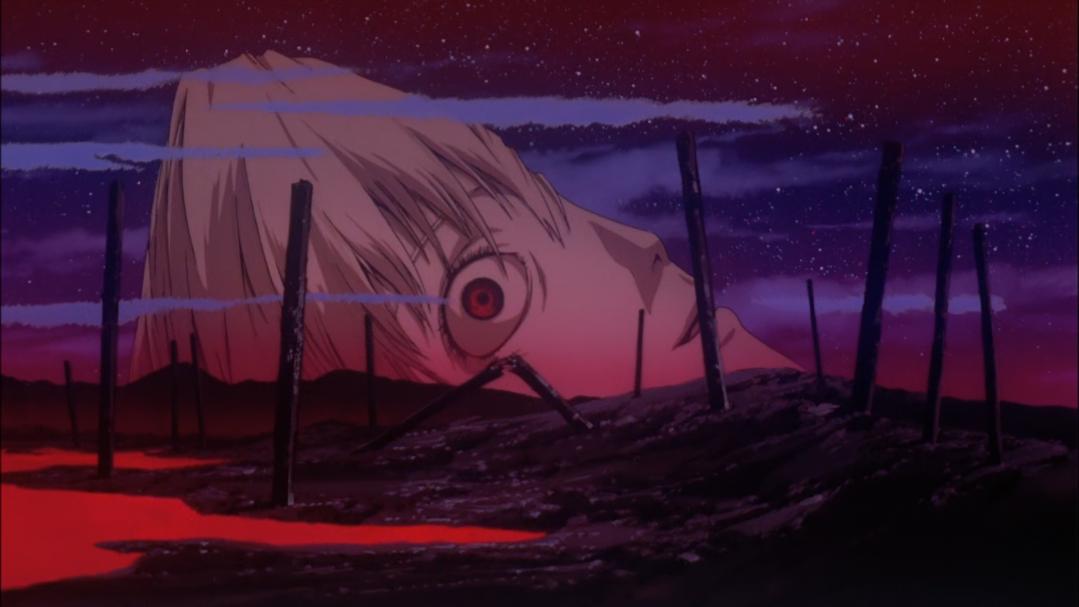
Main article: Theory and Analysis:Final Scene in End of Evangelion
It is often assumed that Asuka was brought back to life either by Shinji willing it or Rei/Lilith/Yui somehow deciding to return her to the real world in order to provide Shinji with companionship, as in the Adam & Eve scenario. However, there is plenty of evidence indicating that Asuka, in fact, has decided to return from Instrumentality herself, out of her own free will: she goes to the beach (instead of just materializing by his side), and finds the markers Shinji set in her and other characters' memory. Immediately she assumes Shinji thinks she's dead, so she kicks the marker with her name to signify she's alive, as well as her will to live. She finds Shinji asleep on the ground. Instead of waking him up, kicking him or yelling at him, she decides to sit and sleep by his side.
This also ties in with the idea that Shinji can somehow force people to return, but all returnees have to decide to do so. Shinji did not force this on anyone, he opened the choice to people. Asuka is simply the first person to choose to return after him.
Asuka did not have the strength to resist Shinji
Another interpretation is that Asuka did not punch or otherwise react aggressively to him choking her again was that she simply did not have the energy to resist. Not only is this disproven by above evidence, Megumi Ogata also details this mirrors the experience of a female acquaintance of Anno's, and this is a deliberate choice on Asuka's part. This is a summary of her interview from Evangelion Forever:
According to Megumi Ogata, Shinji's voice actress, the scene itself was modeled on a experience of a female friend of Anno's. This friend got into an argument with her boyfriend, and at some point he choker her in rage. Instead of reacting violently, this friend felt no fear, hatred or even a need for survivl, but rather a desire to caress him tenderly. In response, her boyfriend lost her grip. However, Anno's friend instead grew cold, and muttered Asuka's line from the EoE draft almost verbatim. Ogata believes this scene was how Anno wanted to "convey different ways how to bring feelings of love to a conclusion that exist in reality. You are you, I am I". Naturally, this reflects on the films of individuality and the duality of reaching out to others present in Eva.
Anno also guided Ogata to treat OMF partly as a separate story: "as something that just exists. As if everything that happened before in the movie is merely a dream that never happened. It is its own narrative unity, something that can fundamentally be taken away from its context in the movie and still be interpreted as a dramatic whole. It is and is not the final scene of EoE."
Furthermore, Ogata asked Anno to help her understand what Anno wanted to convey through the scene and how Shinji is supposed to act. Hearing this, Anno first stands silent and confused for a moment. Then he firmly wraps his arms around himself and hugs himself. This is on the "purpose" of what he is trying to express. As for how Ogata should play Shinji Anno asks her to not play Shinji: " "For this scene alone, I want Ogata to take on and express my feelings rather than Shinji's" - Koji Ide's Evangelion Forever
Shinji wanted to kill Asuka
See above. The official sources make it clear, but please refer to Theory and Analysis:Final Scene in End of Evangelion for a complete explanation. Shinji choked Asuka in order to feel the existence of an Other.
Shinji and Asuka in the new world where the Human Instrumentality Project was not fulfilled Shinji had chosen a world where others existed、and for him Asuka became the first "Other".
During Instrumentality, Asuka encountered Shinji inside his inner world and told him she didn't need anything if she couldn't have all of him. Despite the significance of this statement, Shinji's response was vague at best and he only sought a place at her side because it was a "comfortable" place to be. Hurt by the notion that she was nothing more than an escape for Shinji, Asuka outright rejected him. As a result, the Human Instrumentality Project did not reach its intended result, and any changes to the relationship between Asuka and Shinji were left unclear. - Essential Evangelion Chronicle Side B
"Shinji renounced the world where all hearts had melted into one and accepted each other unconditionally. His desire... to live with 'others' -- other hearts that would sometimes reject him, even deny him. That is why the first thing he did after coming to his senses was to place his hands around Asuka's neck. To feel the existence of an 'other'. To confirm (make sure of) rejection and denial."
"In the sea of LCL, Shinji wished for a world with other people. He desired to meet them again, even if it meant he would be hurt and betrayed. And just as he had hoped/wanted, Asuka was present in the new world. Only Asuka was there beside him. The girl who he had hurt, and by whom he had been hurt. But even so, she was the one he had hoped/wished for...." - Evangelion Carddass Masters;D-88, D-84, P-66, P-68, H-11, full set here.
Asuka and/or Shinji attempted to commit suicide
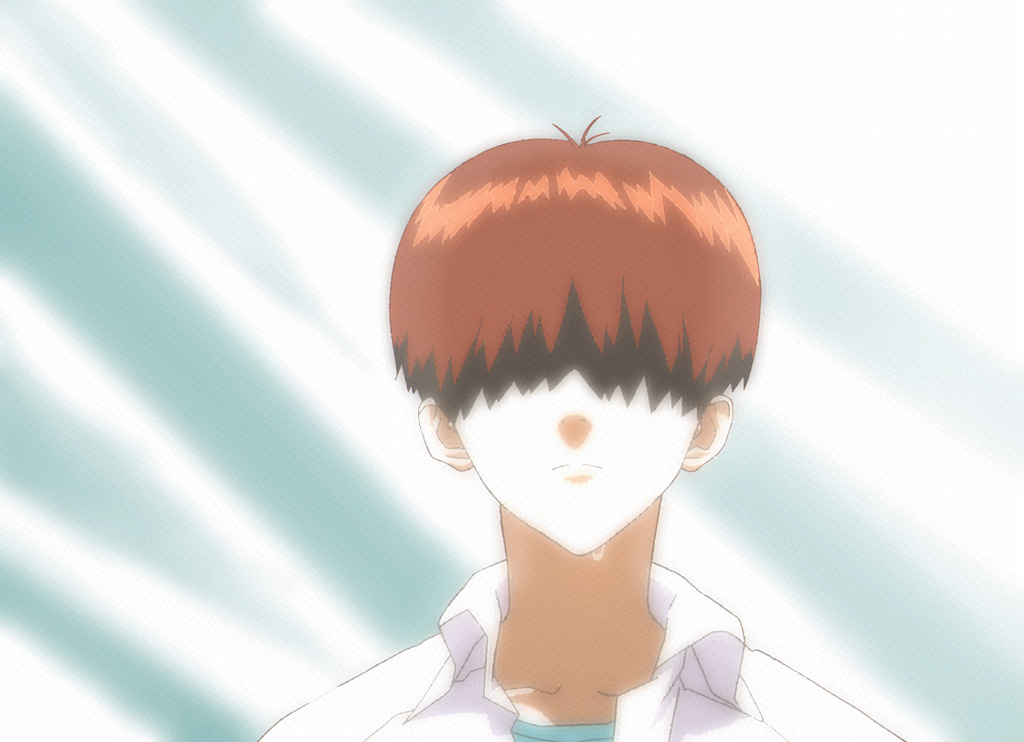
Common theories due to the lack of clear detail on the scenes in Episode 24 and Episode 26', in which Asuka supposedly cut her wrists in a bathtub, and Shinji supposedly tried to drown himself in the lake. In fact, in both instances, several pieces of evidence and thematic considerations invalidate this. In both cases, Asuka and Shinji lost their will to live, but did not have the will to kill themselves either. In fact, both scenes parallel each other and other instances. See the following articles:
Theory and Analysis:Shinji and the Lake
Theory and Analysis:Asuka and the Bathtub
Netflix made the new Evangelion translation, and other localization myths
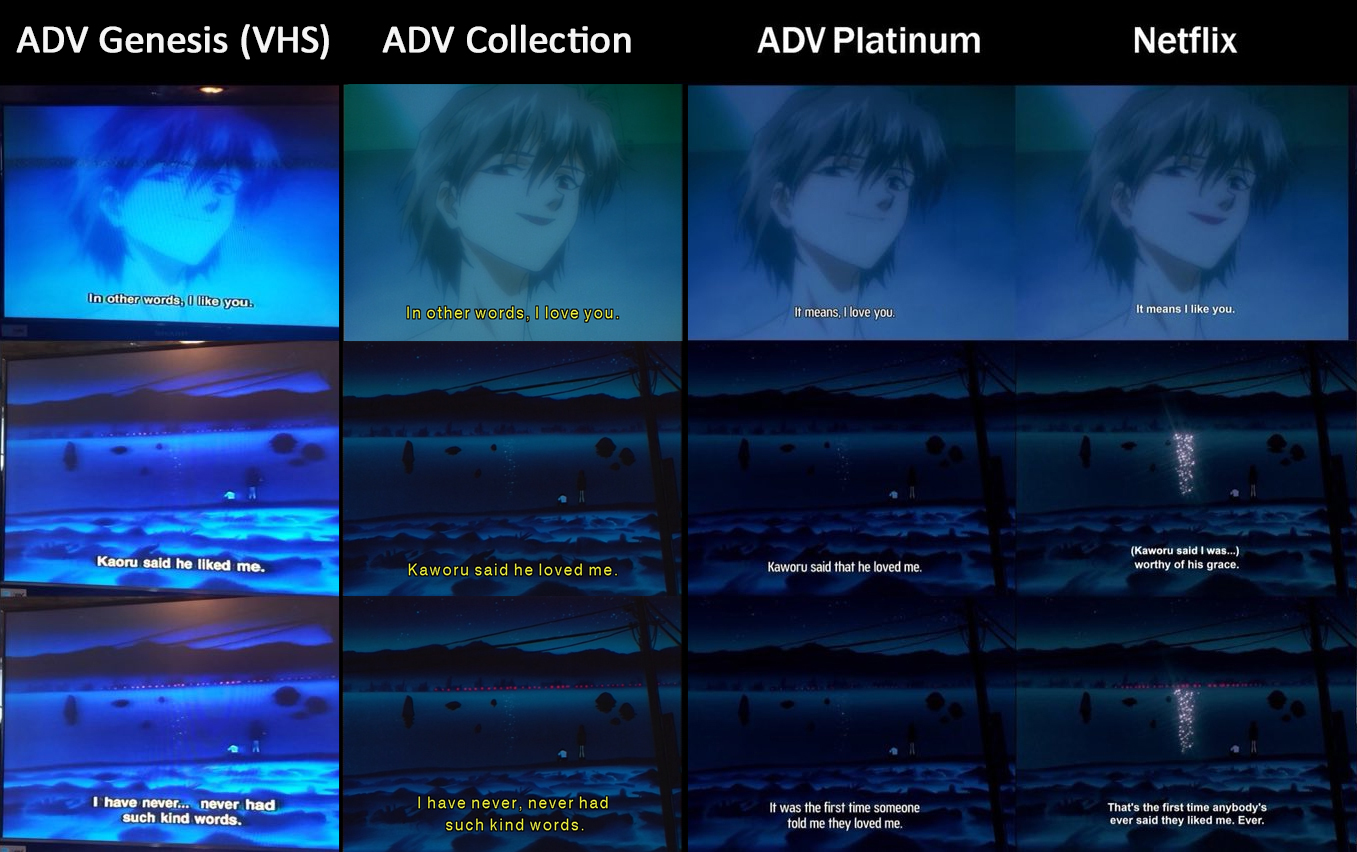
As explained in the first session of Theory and Analysis:Kaworu's lines in Episode 24, Netflix had no hand in the localization of Evangelion, and it was in fact made by Studio Khara's own in-house translator, Dan Kanemitsu. This was the first translation handled directly by the makers of the show, something that did not happen with the older ADV translations of Evangelion, which had multiple problems - it's even sometimes claimed Anno himself oversaw or even made the old translations and Gainax/Khara isn't involved with the new one, when the opposite is true. Some myths are also perpetrated by fans who have watched the show using old fan-made subtitles, often without their knowledge, like the supposedly replaced "worthy of love" line, which was never present in any official English release - it was previously "sympathy" and "regard".
Khara mandated Eva 3.0 to be re-translated due to crowd reactions
_discourse_-_The_Some.jpg)
Related to the myth above. The source for this claim is a completely unsourced post on SomethingAwful, notoriously known as the forerunner of modern Internet "shitposting" and well-knwon for spreading misinformation and trolling. According to this claim, made on the forums the day after Netflix released Eva on their platform, Khara representatives were present for a screening of the dubbed version of Evangelion: 3.0 You Can (Not) Redo, and were shocked at the rowdy reaction of the crowd at the dub. This would have upset the Khara representatives so much that they demanded a new dub and this eventually contributed to the redubbing of the Netflix version. There is zero proof of such representatives being present or any motivator for them to care about crowd reactions, not at the least giving their continuing indifference to Western fans. Besides the inaccuracies, the user's claim that he was there to see it is disproven by schedules. Although 3.0 did indeed screen in Baltimore's 2013 Otakon convention in August 9 that year, it was a subbed version. It was also not the first screening as the user claims, as by that point the film had been screened four times as early as July 12. The very first screening of the dub was done in October 11 in New York, two months later. He is also incorrect about Otakon being six months before the first proper screenings, as those happened in early January. Thus the user was either grossly misremembering, or falsifying information. His most famous claim about the Khara representatives, and for some reason specifically at the fifth subbed screening after other, larger ones for months, followed again by months of open screenings internatiionally, had not lead to this supposed horror and shock by Khara representatives has no backing and is nothing but hearsay.
As detailed in Theory and Analysis:Kaworu's lines in Episode 24, the Netflix redub of the NGE anime series was driven primarily due to the need to fix the many mistakes and one-sided arbitrary changes taken by the ADV dubbing company in the first English dub that stray greatly from the original text. The Eva 3.0 Funimation dub was redone for similar reasons. The early dub was so inaccurate and poorly made it drew enormous criticism at the time, with key character reactions and motivations being disfigured. Notably, there are still many accounts of people who saw it at the time in the forum threads and they make no mention of Khara representatives or the movie being treated as a joke. You can find some here, and snippets of the screenings here. Khara's official explanation was that it had to be brought "closer to the original vision". Later, Khara's refusal to continue with Funimation, responsible for the dub, even drew ire from Funimation themselves.
Anno's involvement with the Neon Genesis Evangelion 2 videogame
As with other myths involving derivative material, this one claims Anno was heavily involved or even wrote part of the Neon Genesis Evangelion 2 video game, which provides the source for the Classified Information material. His only confirmed involvement is being interviewed by the makers of the game, along with other Gainax staff, which helped them with worldbuilding and writing the CI files themselves. They also claim the scenarios present within the game itself are simply made for it and can be disconsidered regarding their canonicity. In a production log, they explain they wanted to create their own "world of Evangelion". This is also expressed in their effort to create an "autonomous" simulation and characters. This allows the player to create numerous scenarios for characters, battles, and relationships.
Near Third Impact and Third Impact are two separate events with different causes
This is a common misconception that is unfortunately aided in its spread by questionable dubbing decisions and the includion of the dub closed captions as a subtrack (saying "Near Third Impact" where the original says "Third Impact"). In the car ride to the purification plant, Kensuke tells Shinji this: "Someone had to sacrifice themselves in order to stop the Third Impact." Kaworu later explains this to Shinji: "Once awakened, Eva Unit 01 opened the Gates of Guf and acted as the trigger to bring about the Third Impact. The Lilin call it the Near Third Impact. You were the key to it all." In the flashback to Kaji's sacrifice, we see Wille markings and Takao cites him as one of Wille's founders, therefore this must have happened after the uprising against Nerv and, subsequently, after Kaworu and Kaji have met, meaning the uprising can't have been in between the end of Evangelion 2.0 and its postcredit scene. Taking these together paints the following picture: -Shinji started the process of Third Impact, before being interrupted by the Spear of Cassius, which closed the Gates of Guf and stalled the surface destruction, but did not end the actual event. -The Wille uprising takes place an unclear amount of time afterwards -Another unclear amount of time passes, when the stalled process resumes; still the same impact even, started by Shinji and carried out through the body of Unit 01 -To bring it to an end for good, Kaji chooses his own life as the necessary sacrifice
Kaworu penetrated Shinji's A.T. Field as his transition guide
Main article: Theory and Analysis:Motherly and Cross Symbolism in EoE

A misconception born out of some easily missed details. After emerging in Eva-01 and seeing Asuka's dead Eva, Shinji panics, not only because of the shock of losing yet another person he cared about, but his last avenue of escape is seemingly gone. To add insult to injury, Rei-Lilith starts gruesomely mutating, and Shinji even sees a giant Rei's mangled head shape-shifting before his eyes. This is enough to drive Shinji further into despair and he enters an absolutely frenzy. By this point he could have conceivably become a danger to the process of starting Third Impact proper, so this calls for some action on Lilith's part. As Shinji is already disturbed and alienated by others, and has just lost what he saw as a last avenue of escape in Asuka (though she returns to being that soon after), Lilith morphs into Kaworu. This calms Shinji down, and Lilith uses the opportunity for the Lance of Longinus to penetrate Unit 01's core and transform Unit 01 into the Tree of Life, as the SEELE councilmen ritually chant in triumph.

This has sometimes been used as evidence that Shinji actively wished for Kaworu in this scene and that he was the motivation for Shinji to enter Instrumentality by being the person he wanted, similarly to what happened for Hyuga with Misato. However, Shinji's scene simply does not play out like that. In fact, the storyboards and script make it clear that it is not Shinji's A.T. Field that is being penetrated, but rather Unit 01's. This is paired with Eva 01 audibly moaning, voiced by Megumi Hayashibara (Yui). After this, Shinji is still visibly present and physically integral. Fuyutsuki also adds that Unit 01 now possess both the Fruit of Life and the Fruit of Knowledge, alluded to by Makoto mentioning the AT Field shifting into "Pattern Red", yet another element associated with the Angels and Evas, but not the pilots. Fuyutsuki then explains that it's now in Shinji's hands, further emphasizing that Shinji hasn't yet entered Instrumentality.
Immediately afterwards, Yui in fact explains that "this Rei represents your very hopes and dreams", and as she says that, Lilith morphs back into Rei. Rei then asks Shinji "what do you wish for", and then Shinji has a vision of a woman's breasts being clutched, then the screen has a "bubbly" effect and turns orange, much like LCL. This is when Shinji enters Instrumentality. Storyboards identify this merely as a "woman's breasts", but the vision resembles Asuka or Misato. Regardless, this scene is not at all about Kaworu or Asuka but rather the overwhelming Freudian/Jungian "return to the womb" themes, to which Kaworu, but also Misato, Rei and obviously Yui have a thematic connection to, and Kaworu's brief appearance is overshadowed by the larger context of the scene both before he appears and after Lilith reverts back to Rei. Additionally, Kaworu is still present in the "back half" of Lilith, suggesting his soul was absorbed (presumably harvested or by Gendo through his Adam implant, which was then absorbed by Rei), which makes this further different from the following Rei apparitions as it is not Lilith having the appearance of that person's wish, but instead Adam as part of herself. In fact, Lilith (Rei) and Adam (Kaworu) fusing was a necessary part of enacting Third Impact, hence why Gendo had the weakened Adam embryo in his hand in the first place, with Kaworu's soul having presumably returned there, being a portion of Adam's own soul, not unlike what happened with other portions of Lilith's soul, or Kyoko's. Thus, we can safely say it's not Kaworu manifesting as a transition guide like for other characters, but instead Kaworu/Adam himself, already fused with Lilith.
-
Storyboard explaining the scene and the easily missed "woman's breasts"
-
...followed by the "waterdrop" motif that is used repeatedly in the series to allude to Yui inside Unit 01, including in the opening.
-

the sandbox scene immediately after, with a toddler Shinji making this more explicit. Notice the "woman's breasts" on the background, and how he is on top of a symbolic womb.


In EoE, Instrumentally is focused on his return to the womb and his anxieties surrounding the women in his life, mainly Asuka, whose affection he desperately, and selfishly, seeks immediately after entering Instrumentality. Kaworu is completely absent from Instrumentality afterwards despite there being every reason for Shinji to go after him if he wanted to, only showing up at the very end in which he completes Rei's lines as Adam. Additionally, Rei and Kaworu later refer to themselves in the plural to Shinji inside Instrumentality, regarding humanity collectively. This simply doesn't match with the idea of Shinji as deeply wanting him or having been brought there by accepting or giving into him in the first place. Far from it, Shinji is still distressed and is still seeking complementation. Retroactively, Kaworu is briefly only mentioned in the series' Instrumentality in the context of Shinji feeling guilty over killing someone he saw as human, and thinking that maybe he did not really kill him would take a weight off Shinji's shoulders.
Even when Shinji says "you were there all along" he is in fact echoing what Asuka says earlier in the movie when she finds out Kyoko is residing inside Unit-02, and Kaworu calls Shinji when he is looking at Misato's cross, his last memory of yet another maternal figure. Both Asuka and Shinji quickly revert to a status of childlike glee. Shinji is looking for an escape, a mother's embrace to let him run away from the harsh reality. Interestingly, an earlier draft of EoE had this made far clearer, emphasizing further (to Gendo) that Adam has been fused into Lilith, as well as her trying to penetrate Unit 01's core. Additionally, Rei herself said Kaworu's line and only briefly morphed into Kaworu afterwards. Of course, except (partly) for the line, this is all still the case in the final version of the movie, but it's less clear, much like how the ending featured in that draft is almost identical but gives far more details compared to the final one.
Misatributed or mistranslated sources
As discussed on What Is Canon?, there are several claims of "official Evangelion material" or statements that are anything but. Often, these are made by third parties, fanmade, or represent non-canon material, like individual routes for video game spin-offs. Somtimes they are real, but misrepresented. These are some of the most commonly cited ones and a counterexample, where applicable.
-
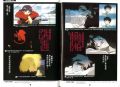
These pages from the Newtype Film Books are real, but are a Chinese translation, not the Japanese original. Some arguments have been made based on the wording, language and characters (kanji/hanzi) used here, but this omits this fact.
-
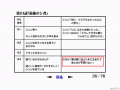
Notably, Kaworu's lines are very different from the Japanese original, rendering this evidence invalid.
-
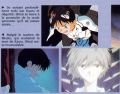
The French release of the Newtype 100% Collection features this paragraph which is completely absent from the Japanese original and has also been spread.
-
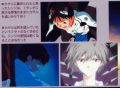
A translation by Reichu of the Japanese original is "Shinji, feeling betrayed by Kaworu, pursues him with his emotions churning in bitterness." It's also the same text present in the D&R program book.
-
![Nagisa Kaworu The fifth Eva pilot whom Seele sent in. To Shinji, he was both the very first friend he could confide in as well as a same-sex romantic interest. On the account of his true nature as an “Angel”, he attempts to merge with the First Angel, Adam, ensconced in Nerv’s underground, to trigger Third Impact. Driven at the far end of his anguish, Shinji kills that beloved friend of his with Eva Unit-01. This opinion of a third-party journalist is sometimes misattributed to Anno. It is in fact this journalist's personal introduction/guide to a book containing interviews with Anno and others, not made by them or authorative. [See more here].](/images/thumb/1/19/SchizoPranoCharacterGuide.jpg/120px-SchizoPranoCharacterGuide.jpg)
Nagisa Kaworu The fifth Eva pilot whom Seele sent in. To Shinji, he was both the very first friend he could confide in as well as a same-sex romantic interest. On the account of his true nature as an “Angel”, he attempts to merge with the First Angel, Adam, ensconced in Nerv’s underground, to trigger Third Impact. Driven at the far end of his anguish, Shinji kills that beloved friend of his with Eva Unit-01.
This opinion of a third-party journalist is sometimes misattributed to Anno. It is in fact this journalist's personal introduction/guide to a book containing interviews with Anno and others, not made by them or authorative. [See more here]. -
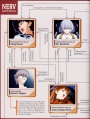
For comparison, official sources such as the Evangelion Chronicle Character Guide make no such statements.
-

A commonly cited excerpt from an excerpt supposedly called "In 1997, KAWORU NAGISA was lost beforehand in End of Evangelion" is in fact from...
-

...a 2008 fanbook, and the supposed source is just a name of one of the chapters.
-
As detailed here, this is the backcover for the 3.0+1.0 booklet. Many fans have claimed it provides official explanations of characters and plot points, but in reality it only lists the terms, not expanding on their meaning. The most circulated example is a supposed explanation of the nature of the Rebuilds' cycle and Kaworu's involvement with the Book of Life.
-
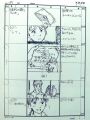
-
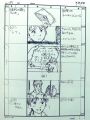
In the real storyboard, she simply tells him "take care and be good to my brother". The author made this clear and apologized for people misunderstanding this parody.


![Nagisa Kaworu The fifth Eva pilot whom Seele sent in. To Shinji, he was both the very first friend he could confide in as well as a same-sex romantic interest. On the account of his true nature as an “Angel”, he attempts to merge with the First Angel, Adam, ensconced in Nerv’s underground, to trigger Third Impact. Driven at the far end of his anguish, Shinji kills that beloved friend of his with Eva Unit-01. This opinion of a third-party journalist is sometimes misattributed to Anno. It is in fact this journalist's personal introduction/guide to a book containing interviews with Anno and others, not made by them or authorative. [See more here].](/File:SchizoPranoCharacterGuide.jpg)


Anno forced Megumi Ogata to choke Yuko Miyamura
Another rumour surrounding the production of EoE, surrounding one of the more violent aspects of Evangelion production. Anno had difficulty in finishing this scene, and in order to get the most realistic performance, Megumi Ogata (Shinji's seiyuu) actually choked Yuko Miyamura (Asuka's). Some say this was Anno forcing them, however it was clearly consensual. The sources don't clarify whose idea it was, however.
MO: I'm delighted that you think I sounded natural as if I was doing ad-libs. I don't remember doing anything experimental. There was a time when I actually pushed Yuko Miyamura to the floor to strangle her during the last scene of the "Evangelion" movie in which Shinji strangles Asuka. I couldn't act very well in playing that scene. I was so agitated that I strangled her too hard, making it impossible for her to say her lines for a while. Of course, I apologized to her for doing that. I almost killed her. - Statements by Evangelion Staff - Megumi Ogata on fandom and choking Yuko Miyamura
CF: Did Megumi Ogata (Shinji) really strangle you while recording the voices for the End Of Evangelion to get a realistic performance?
YM: Yes, she did. I tried many times to make it sound like I was being strangled, but I couldn’t get it right. So, Megumi Ogata helped me make realistic sounds by actually strangling me. She’s nice isn’t she!? - Gold Coast Film Festival 2010
Ogata also says in another interview that the scene was based on the experience of a female acquiantance of Anno's:
"Ogata: It is. At the time of retake, I really strangled Miyamura once. Actually pulled her down to the floor and sat on her. That's why Miyamura's voice couldn't come out for awhile, which was crazy. Ah, of course I adjusted it (laughs) (for her health, so she wouldn't die).
However, there was a time when we (our performance) wasn't given the OK even after I tried several times and it did not go well. So I thought I'd actually try it (choking). I'm glad I didn't become a real murderer (laughs).
Ogata: Yeah. But can I say this? Please check it later. It seems to be modelled after a situation that actually happened to a woman Anno knew. She was being strangled, and at the moment she thought she might be killed—not Anno-san, by the way, just in case—She wanted to caress him, and that's when he came back to reality... Maybe that's what they thought I should try. I'm not the director, so I don't know if it's true or not, but for me, the ending before the eye catch was a mental/spiritual ending, and the scene at the end is a real ending. It was like a snap back to reality, The dubbing was also very real and it was accompanied by a real experience." - Megumi Ogata: Koji Ide's Evangelion Forever
Mari is based on Moyoco Anno, Hideaki Anno's wife
A common rumor surrounding the development of Mari Makinami Illustrious from the rebuild series of films is that she was based on Hideaki Anno's perspective of his wife and reflects her personality. While this theory was seen as grounded in the past as many other characters in the franchise are derrived from various people in Annos life only encouraged by the ending of the final film, during a celebration livestream for the theatrical release of Evangelion: 3.0+1.0 Thrice Upon A Time Anno unequivically denied the rumor and later released the following statement;
We have seen various articles, videos, etc. that claim Mari was modeled after Anno's wife, but this merely only the assumption and speculation of a handful of people. At the time of production, this would have been impossible. Mari's personality (as well as Asuka and others) was created by director Tsurumaki's hand [rather than Anno]. It's a bit of fun for the audience to interpret characters and storylines as they wish, and [Evangelion 3.0 + 1.0] is a playground of intellectual fan speculation. That being said, it is sad to see the staff and their families disparaged by baseless assumptions, so we will clearly deny that this is the case.
Plans for a live-action adaptation
This article bears the unpleasant designation of "Stub." This is a Bad Thing. Provide a great service to NGE fan-geeks everywhere by making it awesomer!
A popular idea, or drem, of many Western fans is to one day see a live-action adaptation of Eva. In the early 2000s, ADV, the company behind the English-localization of NGE, had the same idea. They put considerable effort in trying to get Gainax to sell them the rights for a live-action adaptation, but were repeatedly rebuffed. This went on for almost a decade, until 2011, years after Anno left Gainax to work on the Rebuild movies at Khara, despite ADV's attempts. Gainax returned the money ADV had sent them, which ADV responded by suing them. Thanks to ADV and Gainax ''both'' being semi-defunct now, this legal battle is still somewhat unresolved. Anno later sued Gainax himself for the full Evangelion rights, and won, but he hasn't reached a settlement with ADV. This likely established a bad precedent for Anno when dealing with any prospective adaptations.1 2
Anno has repeatedly also reiterated the Japanese being his targeted audience, and reaffirmed his lack of interest in collaborating with Western creators or a live-action remake, both of which are perennially speculated in the Western fandom:
“Only Japanese animation really explores our interior world and emotions. Japan is probably the only country that makes animation for adults as well as children.”[...] It’s the differences in approach to animation between Japan and the West that makes Anno reluctant to collaborate on international projects. Neither is he interested in live-action remakes of his work. “The mental structure is too different between Hollywood and Japan,” he says. “There may be some Japanese film-makers who can collaborate with Western creators, but I’m not one of them.” - ScreenDaily interview
Anno, however, is not a fan of live-action films derived from his anime. He dismisses “Pacific Rim,” with its “Evangelion”-inspired tussles between giant aliens and human-piloted robots, as “not so interesting.” Hollywood plans for a live-action “Evangelion” remake leave him cold. “‘Evangelion’ was conceived as an animation,” he says. “It would be hard to express in live-action.” - Hideaki Anno: Emotional Deconstructionist
On the Rebuilds ending Evangelion and the future of the franchise
Partly because of the common notions that Eva is a lot less commercially significant than it really is, or lack of understanding of the Japanese media and cultural landscape, a lot of English-speaking fans believe that Anno firmly intends to end the Evangelion franchise for good with Evangelion: 3.0+1.0 Thrice Upon A Time, partly because of the perceived "finality" of its ending. In reality, part of the purpose of the Rebuilds involves them serving as a springboard for the launch of the Evangelion franchise as a "pillar" of mature anime, as well as launching Studio Khara as a hallmark of the anime industry. They had, however, no desire to make a direct sequel to the series. This is also integrated into Anno's perceptions of stagnation of the anime industry, and his stated desire to revive it, commercially and artistically:
Specifically, among the stagnant mood of the present day, it is the portrayal of will - not technology - that is most important. To support the fans that support animation, we felt that a work that would appeal to middle and high school-aged men, who quickly grow away from Anime, was necessary. When we decided that we wanted to something to support the anime [industry] of today, the determination to return to this title was strong. - Hideaki Anno: Statement about New Evangelion Movies, February 2007
Anno has intended this since 2000, and his intentions moving forward include opening up the franchise to new creators. Unfortunately, a significant part of the sources dealing with this information have only been translated as late as as 2021, and a considerable portion remains only partly so. The 2021 NHK documentary included some lines by Anno that, out of context, have been used to argue the franchise in indeed over, but this misses these other informations. Some lines have even been mistranslated on the fan subtitled (and unextended) version of the documentary. There is a widely circulated screenshot of Anno being asked if he has any emotional attachment left to me the series, and denies it. In reality, Anno was asked about whether he'd miss working on it. Though he denied it to the crew, he later told Ogata during post production that he'd indeed miss it. Assistant director Kazuya Tsurumaki, and Anno themselves went into detail about this in their recently translated Evangelion 1.0 Complete Records Collection interview, a document from 2007 - not the 2.0 CRC ones, which were translated many years ago. Sadly, their late translation meant much of this went ignored by Western fandom. In it Anno considered "Evangelion Part 2" as a new addition to the story, but was unable to move the project forward, as from the start he wanted it to be handled by other creators, but too many of his colleagues in the industry were unwilling to participate on the massive undertaking that continuing Evangelion would be. He likened this initiative to G Gundam, calling it "G Evangelion" at the time. In Gundam canon, this is the series that ended the "mainline" storyline, as the first series that had no direct involvement from Gundam's main creator, Yoshiyuki Tomino, naturally one of Anno's mentors and greatest influences. For that matter, one of the reasons why Anno so much as started making Eva originally was to try and overcome Tomino. Ironically, he'd say the same about Anno years later.

After years of working on other projects, the Rebuild project started solidly in June 2005, and by now Anno had decided on the current model. Initially, the Rebuilds would be mostly a retelling of the original series, and only the ending would be markedly different. Incidentally, fandom speculation at EvaGeeks and elsewhere at the time assumed the films would be a straight-up remake of each "arc" of the series, which seemed to be a natural assumption following Evangelion 1.0:
Tsurumaki: I was misunderstood at first, and ended up "participating" in the project before I understood exactly what was going on. When I first heard about the project, I was called by Anno, and I was thinking, "What, what?" He asked me out of the blue, "What would you like to work on next after GunBuster 2, Evangelion 2 or the new work of a very famous anime?" I was confused, but as I was giving my opinions on this and that, I came to the conclusion that "Eva 2" was the way to go. At that time, Anno's new work was supposed to be a completely different project from "Eva".
Interviewer: Is "Eva 2" something different from the "New Movie" that you're working on now?
Tsurumaki: I had assumed that Anno's next anime would be called "Evangelion 2". Even so, it's not a pure sequel, it's something as different as "First Gundam, Gundam 0079" and "MOBILE SUIT GUNDAM SEED". In short, the anime that Anno-san is going to make will all be titled "Evangelion". For example, a work like "The Gutsy Frog" would be called "The Gutsy Evangelion", and "Star of the Giants" would be called "Baseball Evangelion". It's a kind of branding, like "VAIO" for all Sony computers. That's what he meant by "2". At that time, there was talk that if I wouldn't do it, he would assign it to someone else. Apparently, Mr. Anno wasn't going to officially direct the film, so it was okay to have a completely outsourced staff.
Interviewer: I see. There has been talk of a "G Evangelion" like the "Mobile Fighter G Gundam" in the Gundam series for a while, hasn't there?
Tsurumaki: Now that I think about it, there must have already been talk of a compilation at that time. But I just assumed that he was talking about "Evangelion 2" and listened to him. I told him, "If you're going to make Eva, you have to do it yourself, and if you're going to do anime again, I'll have to help you."
Interviewer: So there was a twist in the story, and it turned out that Anno's next project was a remake.
Tsurumaki: That's how it ended up (laughs). To be honest, if it hadn't been for the Evangelion remake, I think I would have felt more comfortable participating. That's my honest opinion.
[...] Tsurumaki: Yes. This "New Movie" is practically becoming "Evangelion 2". I don't know if Anno originally had this in mind, or if he just came to his senses during the script writing meetings. At first, it was just a compilation.
Interviewer: That's what everyone has been saying.
Tsurumaki: It's been a little over a decade since the TV anime ended, and for new fans who want to watch "Evangelion" now, it would be hard to rent all 26 TV episodes and the movie version at a video rental store. So if you're wondering, "What's the story behind Evangelion?", If you want to know what Evangelion is all about, you can rent it and watch the whole thing in about three to four hours on a holiday. If that's the way "Evangelion" is going to be developed in the future, it's better for business. Besides, it would be relatively easy to make. We were just saying, "Let's make it easy." At first, it was just a compilation.
Interviewer: In reality, though, you've come to a place that's far from easy at all.
Tsurumaki: According to the original plan, after "GunBuster2" was finished last summer, I completed one film every six months, and by the end of this year (2007), the trilogy was completed. It was supposed to be finished in a year and a half. - Tsurumaki, Eva 1.0 CRC (2007)
Tsurumaki: When we started the Rebuild of Evangelion series, about 10 years had passed since the TV series, and the number of fans had changed and the number of younger people had increased. So we decided to make a compilation that would allow people to enjoy Eva without having to watch the entire TV series. That was the starting point. We started with the idea that only the end of the four-part series might change, but basically 80% of the series would be a compilation, but that started to shift with ":2.0", and ":3.0" will start from a scene 14 years later, which is not even depicted in the TV series...
--So it became something unexpected along the way.
Tsurumaki: I thought that we were going to make something that would not put Anno in a state where he would be trapped like he was in the TV series and the previous "film version". I thought, " We've already experienced the extremes of that kind of thing, so we've had enough of that." I thought, "It's good to be able to make 'Eva' 10 years later, looking at the chaos from a bird's eye view." By doing so, it would result in a more " easy to watch" Eva. However, as it turned out, I got caught up in the chaos once again in ":3.0" (laughs). - Tsurumaki, 3.0+1.0 booklet interview (2021)

This is also alluded to in a 2006 interview from producer Otsuki: - In such a situation, between early summer next year and early summer 2008, you will release "Evangelion Shingekijoban," a reconstruction of the TV series version of Eva divided into four parts. But, what is your aim? I think what many fans expect from you and Director Anno is a "second Eva" and not an "Eva remake."
Otsuki: This is often misunderstood, but it's true that I have never once said to Anno-san, "let's do a sequel to Eva," all these past twelve years. Because, to perverse people, if you say something like that, you've all of a sudden lost your enthusiasm (laughing). However, at last I recieved the following words from Anno-san: "I want to first of all create the 'foundation' for creating the 'next Eva'."
Otsuki: Right. If I say too much it will be a spoiler (laughing). With the situation of society at that time, Anno-san's internal problems, and so on, and especially because the film version ended ruinously, with the world destroyed and Shinji and Asuka the only survivors, continuing the Eva of twelve years ago is not possible. However, with the passing of twelve years, and the turn of a [new] age, Anno-san has settled things within himself. The new films should be, in a sense, Eva with a happy end, or if I had to express it in a single phrase, a story which leads to hope.
- However, hearing that I worry that [Eva] will become like Gundam in the "bad sense," and that from now on nothing but sequels to Eva will be made.
Otsuki: Anno-san says that he wants to make [Eva] Gundam in the "good sense." After all, despite the fact that in tokusatsu there are standards like "Kamen Rider" and "Ultraman" which stand towering over everything, in the world of anime there is only "Gundam." Because of that, we want to make Eva into a new standard for the world of anime with these films.
In 2016, Anno gave two interviews that reached the English-speaking fandom. These are somewhat well-known, but lack this additional context, and have been put into doubt by the NHK documentary, which also led many fans to believe Anno's "Gundamization" project was in fact an idea he had just came up with at the time. This was also in light of Khara's Animator Expo event, which featured 20 animated shorts, including three based in the Evangelion universe, but not canon to it, another Impact, Neon Genesis IMPACTS and until You come to me. Anno is currently involved in promoting new talent and works in the industry, and the Evangelion franchise is meant to be part of this:
For the future, he wishes Evangelion will become a cultural icon, one of the cornerstones of anime, much like Gundam, which has become an institution in and of itself. Like Gundam, where many creators can play around with the elements and create their own worlds, it is Anno's hope that Evangelion can also be set free, to be reconstructed and reinterpreted in many ways by many other artists.
[...] However, he feels confident about the future outlook. The Japan Anima(tor) Expo has been a brilliant success in the effort to expand not just people's understanding of Japanese animation, but also promote Khara's name to the world along with it. - Evangelion Creator Talks the Future of the Franchise
H. Anno: I felt like I couldn’t do anything that belonged to me at Gainax anymore. Once I was done helping Imaishi and the others with establishing projects, I felt that if they were able to do what they wanted to, I would indeed become a hindrance.
At what point have you started working on the Evangelion New Theatrical Versions?
H. Anno: Before creating this company, I was working on two anime projects, this one and another one. However, to raise funding for the company, we decided to start with the new Evangelion movies.
At first, the idea was to use a reissue of the TV Series as groundwork,[...]
That’s why I called it Rebuild at first. We were using the existing pictures and shooting the episodes digitally.
[...] H. Anno: No, at first, we were thinking about contracting another studio to do the show. Thanks to King Records’ Toshimichi Otsuki (Executive producer on the Evangelion New Theatrical Version series), we visited several studios. Still, since the making of Eva is very singular, it didn’t work out well. That’s when producer Munetada Ogasawara (now at Kinema Citrus) said: “We should do it by ourselves.” He immediately found a place we could use as a studio.
If we’re only doing Eva, we’re going to be labeled as “the studio that does Eva.” But I plan on doing many different things.
Obviously, because I want them to be appealing works, it won’t be without specific conditions, but I will not confine them to what my works have established. Just like Gundam, which keeps continuously supporting the animation world, Eva can become a new pillar. After all, it is the purpose that led me to resume through the New Theatrical Versions. I want to maintain this pillar, which carries the animation world. The more pillars there are, the better for the environment will be, won’t it? That’s how I see it. Rather than for my company, I do this for the wellbeing of the animation industry. Gundam can be enjoyed through various works, and it would be nice if Eva can develop in the same way. I think it’s better if there is a diversity in the works. - 10 Years of Khara, interview with Hideaki Anno
Similarly, 3.0+1.0 included a lot of newer staff, like animators and artists, and even directors that were outside Gainax's old core staff, as Anno is seeking to develop new talent. As detailed on the NHK documentary, Anno himself intended to initially maintain a relatively hands-off approch to the development of the film, and leave it mostly to Tsurumaki, but he progressively took on a larger role.
"Well, I first saw "EVANGELION:3.0+1.0 THRICE UPON A TIME" at the first preview. At the screening, I had a chance to talk with Kazuya Tsurumaki, and he and I were talking about whether or not it would have been better if the word "End of Story" hadn't been included (laughs). We talked about the possibility of having a different world from the current one, and that there are many more possibilities." - Ogata Newtype Interview
Accordingly, two new interviews released just before the international release of 3.0+1.0 in August 2021 have surprised a lot of fans, but they are in fact not bringing new information. This mentions Anno's musings of returning to the franchise eventually, as already done at his initiative, and by supervising Tsurumaki, on the EVANGELION 3.0 (-120 min.) prequel manga to Evangelion 3.0, released alongside the 3.0+1.01 re-release, both of which are already additions to the franchise done after the supposed "definitive ending. He also detailed the undeveloped plans for a film set during the timeskip in-between 2.0 and 3.0 in the July 11 stage greeting. However, this might be handled by another creator, as at least for now, 3.0+1.0 is intended to be Anno's final Evangelion work:
"There's always the 14-year gap in the story, so in some form, I want to shed light into that. [...] At this point, I don't feel that I'm going to continue the story where I left off." - Evangelion' Creator Hideaki Anno Reveals 'Evangelion 3.0+1.0' Might Not be the End
“I don’t feel a need to see Shinji and the other characters any time soon. But that doesn’t mean I don’t want to see them ever again: There might come a time when I meet them again.” - Evangelion’ Director Explains How He Finally Found His Ending

Incidentally, Mamoru Oshii, another famous anime director, has expressed his opinion that Hideaki Anno is More of a Producer Than a Director These Days. In a later interview with comedian Hitoshi Matsumoto, Anno himself later echoed this, saying that as a director he could afford to be a child, but not after he started producing. Likewise, Anno is is now considered Hayao Miyazaki's (of Ghibli) successor and one of the anime industry's leading figures, and has been so for years, another fact largely unknown to Western fans. It is also because of this that Japanese fans largely expect more Evangelion content in the future. Additionally, Tomino himself also later went back to work on the Gundam franchise not many years later. Note also Khara's continuing insistance on tightly controlling English localization of Evangelion ever since Eva 3.0's re-dub, released in 2016, then continuing on to the Neflix NGE release and Amazon's Rebuild release. Popular interest also remains extremely high, as can be seen NHK's making-off documentary, EVANGELION: 3.333 Breakdown (under Anno's supervision), the high number of interviews and articles done in the 6 months between Japanese and international release, with more on the way. He has also reiterated the Japanese being his targeted audience, and reaffirmed his lack of interest in collaborating with Western creators or a live-action remake, both of which are perennially speculated in the Western fandom:
“Only Japanese animation really explores our interior world and emotions. Japan is probably the only country that makes animation for adults as well as children.”[...] It’s the differences in approach to animation between Japan and the West that makes Anno reluctant to collaborate on international projects. Neither is he interested in live-action remakes of his work. “The mental structure is too different between Hollywood and Japan,” he says. “There may be some Japanese film-makers who can collaborate with Western creators, but I’m not one of them.” - ScreenDaily interview
Anno, however, is not a fan of live-action films derived from his anime. He dismisses “Pacific Rim,” with its “Evangelion”-inspired tussles between giant aliens and human-piloted robots, as “not so interesting.” Hollywood plans for a live-action “Evangelion” remake leave him cold. “‘Evangelion’ was conceived as an animation,” he says. “It would be hard to express in live-action.” - Hideaki Anno: Emotional Deconstructionist
Due to some ambiguous comments in the NHK documentary, some fans speculated Anno had changed his mind by 2022. Nonetheless, in the Q&A session Khara held for 3.0+1.0's first anniversary, Anno reaffirmed his intention:
Q: You once said that you hope future generations can continue the EVA franchise like the Gundam franchise. Have you changed your mind?
A: I haven’t changed my mind. It will be great if my work should can be of full help to the anime industry.'''A: I haven’t changed my mind. It will be great if my work should can be of full help to the anime industry.
[...]Q: Has Mr. Anno’s Evangelion really ended?
A: Since I have already ended it 3 times, I am good for now, I hope. - First Anniversary Khara Q&A
We're not yet done playing Asuka or Rei - Miyamura on Hayashibara's Tokyo Boogie Night, March 19 2023"
"Hmm, there may be something to that. The prospect of an Evangelion sequel made by someone other than myself could exist. I haven't decided yet - or rather, it's better for the work if there's a high degree of freedom. Whether it's commercially viable or interesting would depend on the content. It's not like I'm saying I'll never make another one again or anything like that." - Anno in a April 2024 expo, translated on [1], however, other translators point out he might have be more actively teasing it. See the full interview on the forums, where Anno details being exhausted from making his last live action films.
Notes
- ↑ The Essential Evangelion Chronicle: Side B


